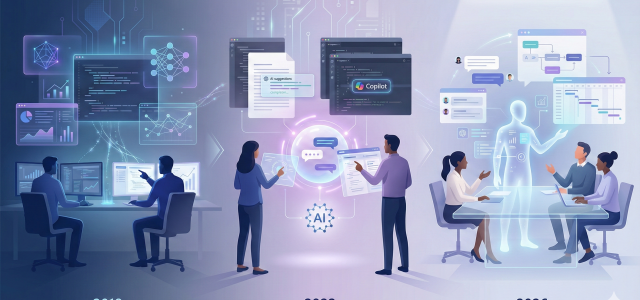
"By 2018, AI development platforms had matured significantly. Self-service machine learning began to take hold: for example, Google Cloud AutoML and services like DataRobot let domain experts train vision or tabular models without coding. In practice, an analyst could upload data and let the system automatically try hundreds of models and hyperparameters."
"Under the hood, AI frameworks were being standardized: the release of PyTorch 1.0 and the promotion of the ONNX format meant models could be trained in one framework and deployed in another. In other words, AI 'tools' in 2018 focused on unifying pipelines - teams could build, debug, and productionize models faster."
Over the past decade, artificial intelligence has transformed from hidden backend systems to visible workplace partners. In 2018, AI democratization occurred through self-service machine learning platforms like Google Cloud AutoML and DataRobot, enabling domain experts to build models without coding expertise. Standardized frameworks like PyTorch 1.0 and ONNX format unified development pipelines, accelerating model deployment. By 2020, generative AI emerged as a major breakthrough with systems like GPT-3. This progression continued with conversational AI assistants in 2022 and evolved toward integrated AI copilots and teammates by 2025-2026. Understanding this timeline helps engineering and analytics leaders prepare their teams for each adoption stage.
#ai-evolution #workplace-automation #machine-learning-democratization #generative-ai #ai-adoption-timeline
Read at Medium
Unable to calculate read time
Collection
[
|
...
]