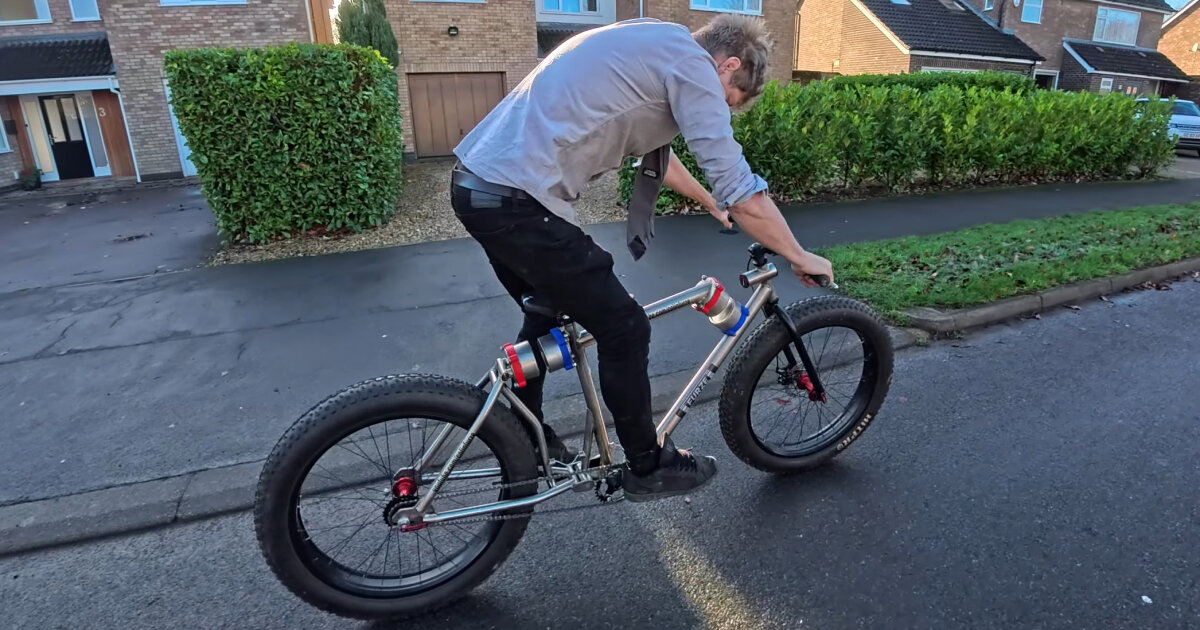
"The first ride of the recycled bike with magnets fails because the frame flex overwhelms the system. The magnets work, but the ride itself does not. The content creator realizes that the issue is not magnet strength but the geometry and load paths. So for the second frame, he built it from thicker stainless steel tubing with reinforced joints. Cables are added to control separation when the bike is lifted, and each change responds to a specific failure observed during use."
"Larger neodymium magnets perform better but introduce new problems because they attract tools, pull fasteners loose, and resist handling. The creator then chooses aluminum and stainless steel for the parts near the magnets. In this case, the frame itself becomes part of the problem and the solution. The final version, then, works within these limits. On flat ground and uneven paths, the recycled bike with magnets absorbs vibration."
A discarded bike frame was modified to replace mechanical compression with magnetic repulsion, using opposing magnets to provide spring-like resistance. The design changed the bicycle from a fixed triangle to a hinged structure and added attracting material at concentrated closing forces. Initial testing failed because frame flex and geometry prevented effective load paths, prompting a second frame built from thicker stainless steel with reinforced joints and control cables. Common iron magnets lacked force, so larger neodymium magnets were used, creating handling and interference problems mitigated by aluminum and stainless parts near the magnets. The final build absorbs small bumps without seals, oil, or traditional dampers.
Read at designboom | architecture & design magazine
Unable to calculate read time
Collection
[
|
...
]