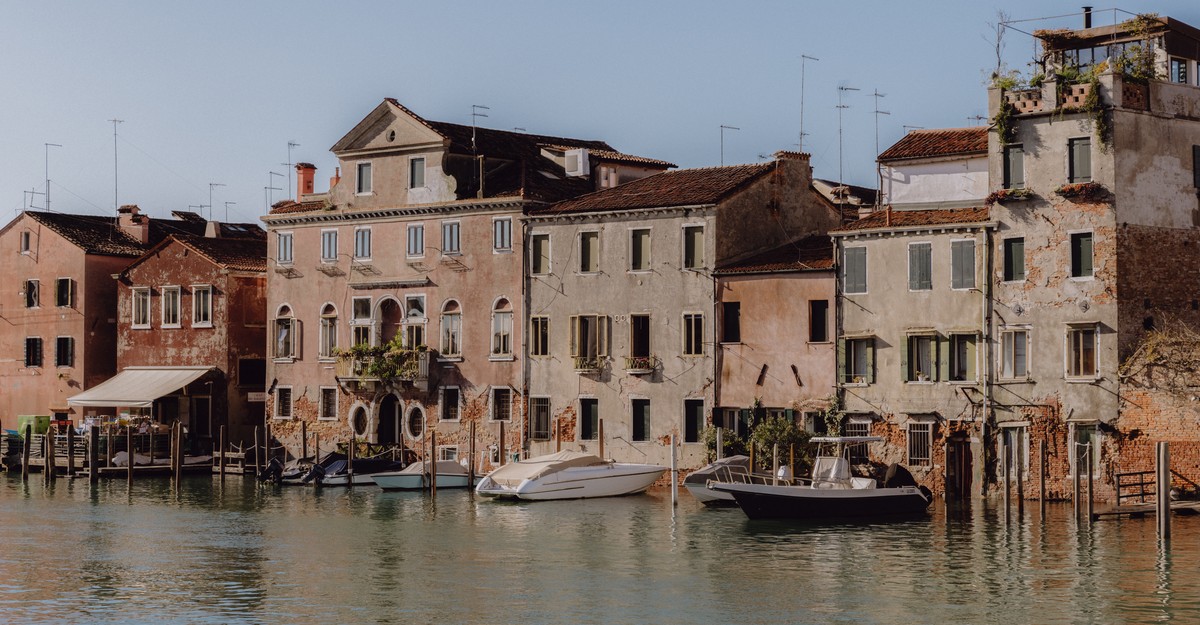
"The narrator has arrived at the dilapidated palazzo by gondola, together with his friend Mrs. Prest. He is plotting to meet the elderly owner, Juliana, the former mistress of a famous, long-dead poet, Jeffrey Aspern. She owns a collection of reputedly scandalous letters from the poet, and has guarded them from scholars and souvenir hunters for many decades. The narrator wants them. 'Hypocrisy, duplicity,' he tells Mrs. Prest, 'are my only chance.'"
"In The Aspern Papers, a novella serialized in The Atlantic in 1888, Henry James lets the narrator, a literary scholar whose name we never learn, describe the wall. "It was figured over with the patches that please a painter, repaired breaches, crumblings of plaster, extrusions of brick that had turned pink with time," he writes. "It suddenly occurred to me that if it did belong to the house I had my pretext.""
A literary scholar arrives at a dilapidated Venetian palazzo to obtain scandalous letters from the late poet Jeffrey Aspern. He plots deception, enlists Mrs. Prest, and rents unused rooms under a false name, feigning devotion to gardens to gain access to Juliana, the poet's elderly former mistress, and her niece Tita. A garden hidden behind a high brick wall becomes the focal point and the narrator's pretext. A modern visitor similarly seeks that invisible garden in Venice, hoping to see the city of intense beauty and deep secrets that Henry James shaped through his visits.
Read at The Atlantic
Unable to calculate read time
Collection
[
|
...
]