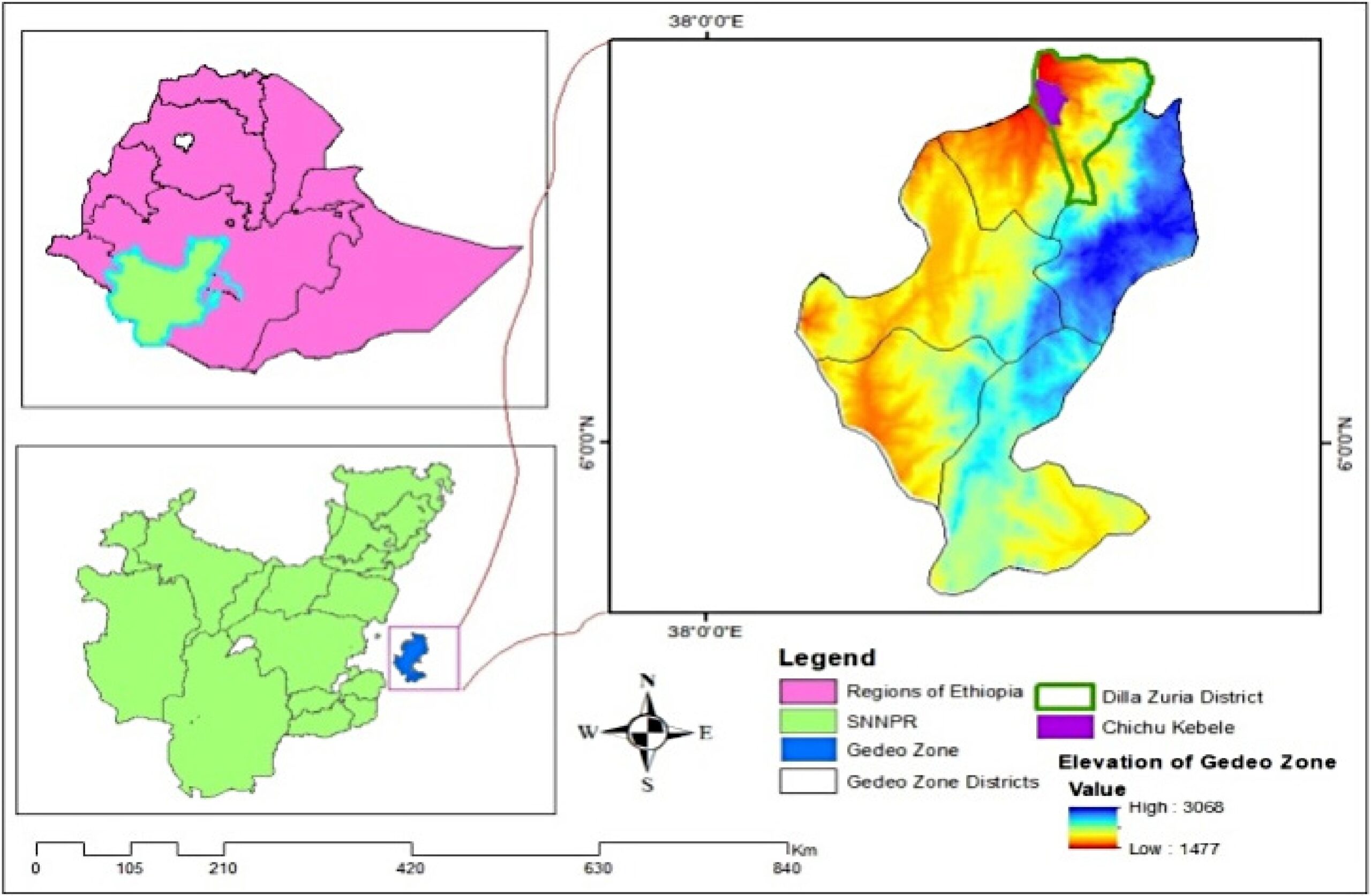
"A decade of farm-level data from Ethiopia's Gedeo Zone suggests coffee quality and yield are not dictated by a single factor such as altitude. Instead, the strongest quality signals may be traced back to multiple related factors affecting soil health, with results varying by micro-region. The study reinforces commonly held best practices in sustainable agricultural land management - such as the inclusion of shade - while rejecting the idea of a one-size-fits-all playbook for different growing areas."
"Using statistics designed to shrink a long list of variables into a smaller set of "what matters most" for total coffee production, the team reports that 12 principal components explained 95.4% of the total variation in the dataset. In the analysis, soil cation exchange capacity - a measure tied to how well soil holds nutrients - was the largest single contributor to variation, while "evapotranspiration" and shade trees were also leading variables. Other important variables included nitrogen, altitude, ash,"
Decade-long farm-level data from Ethiopia's Gedeo Zone show coffee quality and yield are influenced by multiple interacting factors, especially soil health, with effects differing across micro-regions. Analysis of farm records (2013–2022) combined with topography, climate, soil data, farmer interviews and GIS revealed 12 principal components explaining 95.4% of variance. Soil cation exchange capacity was the largest contributor, with evapotranspiration, shade trees, nitrogen, altitude and ash also important. Findings support sustainable land-management practices like shade inclusion while rejecting a one-size-fits-all approach and emphasize local adaptation under climate pressure.
Read at Daily Coffee News by Roast Magazine
Unable to calculate read time
Collection
[
|
...
]