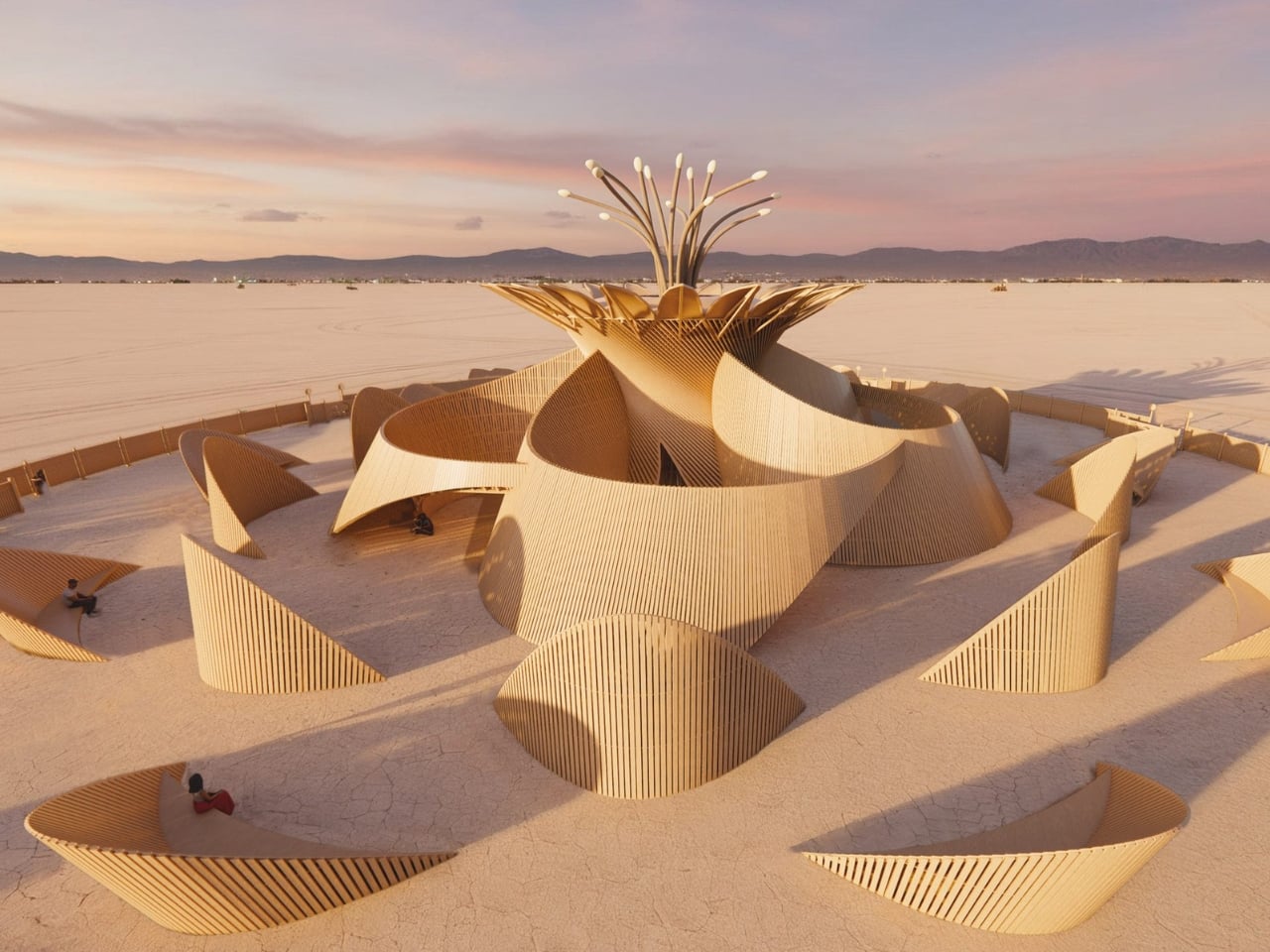
"The 2026 edition, called the Temple of the Moon, might be the most quietly devastating one yet. Designed by artist James Gwertzman, the structure takes its inspiration from the epiphyllum oxypetalum, better known as the Queen of the Night, a cactus flower that blooms exactly once a year, only at night, releasing its fragrance before wilting by morning. It's the kind of plant that demands you pay attention, because if you're not watching, you'll miss it entirely."
"Gwertzman came to this design through a deeply personal place. He spent years walking alongside a friend as she lost her partner to pancreatic cancer, learning what it means to simply be present in someone else's pain without trying to fix it. Before all of this, he was trained in theater as a set and lighting designer, then spent decades in the video game industry building interactive worlds."
"Gwertzman and his team used a parametric design method, essentially algorithmic generation, to create complex organic curves out of straight pieces of timber. It's the kind of technical problem-solving that sounds counterintuitive: using math to fake nature. But the result, at least from the renderings, is stunning. From above, the structure looks like a fully bloomed flower, with slatted wooden petals radiating outward from a central chamber."
Burning Man's 2026 Temple of the Moon, designed by James Gwertzman, draws inspiration from the epiphyllum oxypetalum, a cactus flower that blooms once yearly at night before wilting by morning. This metaphor explores grief, presence, and witnessing transience. Gwertzman developed the concept through personal experience accompanying a friend through her partner's death from pancreatic cancer. His background spans theater set and lighting design and video game world-building. The temple employs parametric design methodology, using algorithmic generation to create organic curves from straight timber pieces. From above, the structure resembles a fully bloomed flower with wooden petals radiating from a central hyperboloid chamber, combining mathematical precision with natural aesthetics.
#burning-man-temple-design #parametric-architecture #grief-and-impermanence #queen-of-the-night-flower #ephemeral-art-installation
Read at Yanko Design - Modern Industrial Design News
Unable to calculate read time
Collection
[
|
...
]