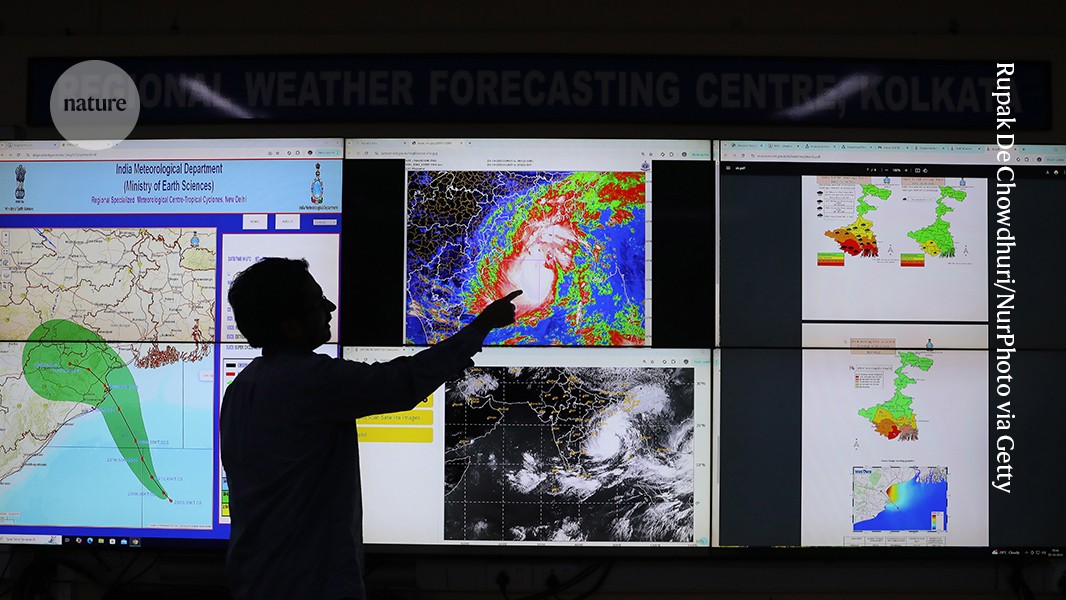
"Back in the 1970s, there were four tropical cyclones that killed tens of thousands or even hundreds of thousands of people, whereas today these storms rarely cause more than a few dozen deaths. It was also in the 1970s that there was a turning point, when meteorological agencies around the world started adopting physics-based numerical weather-prediction models."
"AI models map current weather conditions directly to a likely future state, using algorithms that have been trained on past weather data. Most of the heavy computing happens during the training, so generating an AI-based forecast mainly involves passing the observational data through layers of simple arithmetic operations - such as multiplication and addition - which modern computers can perform quickly."
"A 14-day global AI weather forecast can be produced two hours earlier than can one by a physics-based system - a potentially crucial margin when organizing evacuations. But there is a catch: as yet, scientists do not know how reliable AI-based predictions are when it comes to rare, extreme weather events."
Weather forecasting has dramatically improved since the 1970s when meteorological agencies adopted physics-based numerical models that simulate atmospheric conditions using fundamental laws of motion and thermodynamics. These advances enabled timely evacuations and reduced tropical cyclone deaths from tens of thousands to mere dozens. Artificial intelligence weather models now promise faster forecasts by mapping current conditions directly to future states using trained algorithms, producing 14-day global forecasts two hours earlier than conventional systems. However, scientists remain uncertain about AI model reliability for rare, extreme weather events, particularly as climate conditions change beyond historical training data parameters.
#artificial-intelligence-weather-forecasting #physics-based-prediction-models #extreme-weather-reliability #forecast-accuracy-and-speed #climate-change-adaptation
Read at Nature
Unable to calculate read time
Collection
[
|
...
]