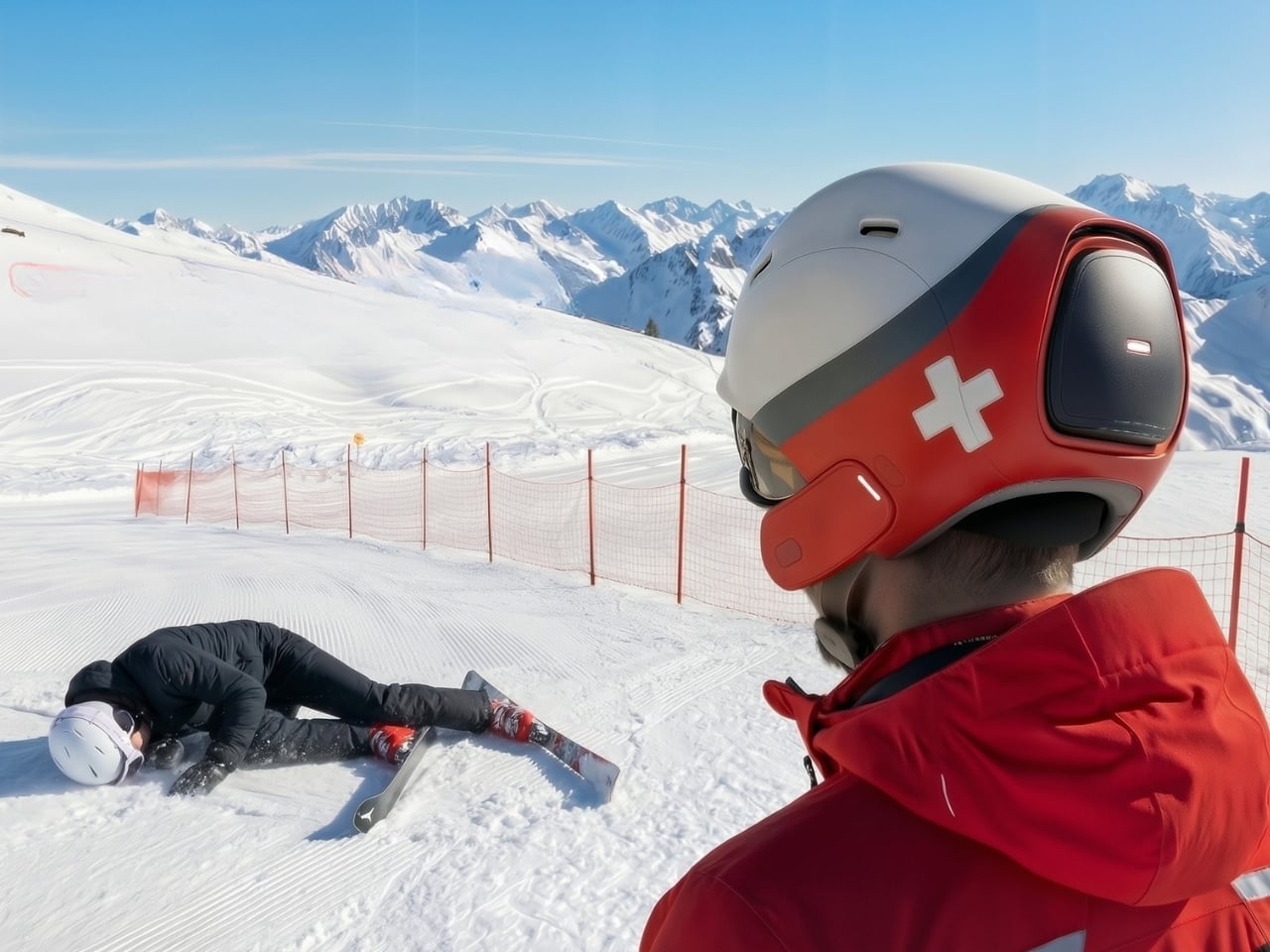
"Imagine being a ski patrol responder racing toward an injured skier on a freezing mountain. Your hands are gripping poles, your attention is split between the terrain and the emergency ahead, and your radio crackles with critical information. Now imagine if you could access maps, communicate with your team, and log vital data without ever touching a device. That's exactly what the Argus AR Helmet promises to deliver."
"The helmet's standout feature is its eye-tracking interface. Instead of fumbling with buttons or voice commands that get lost in howling wind, users control the AR display simply by looking at what they need. Want to view a map overlay of the ski area? Glance at the navigation icon. Need to send a message to base? Your eyes do the work. The system is built around the idea that in high-stress, time-critical situations, the fewer steps between thought and action, the better."
"Mountains are loud. Wind, equipment, helicopters, and panicked voices create a constant wall of sound that makes radio communication frustrating at best and dangerous at worst. Argus addresses this with real-time conversation-to-text conversion. Spoken words are automatically transcribed and displayed on the visor, ensuring that critical information doesn't get lost or misunderstood. In an emergency where "stop the area" versus "stop near the area" could mean completely different courses of a"
Argus AR Helmet is a hands-free augmented reality helmet designed for ski patrol rescue use, created by Hyeokwoo Kwon and Junho Park. The helmet uses an eye-tracking interface to let users control maps, navigation, and messaging simply by looking at on-visor icons. Real-time conversation-to-text transcription converts spoken radio communications into readable text on the visor to avoid miscommunication in noisy mountain environments. The design prioritizes minimizing physical interaction and streamlining decision-making in time-critical, high-stress situations, enabling responders to stay focused on terrain and patients while maintaining team coordination and logging vital data.
Read at Yanko Design - Modern Industrial Design News
Unable to calculate read time
Collection
[
|
...
]