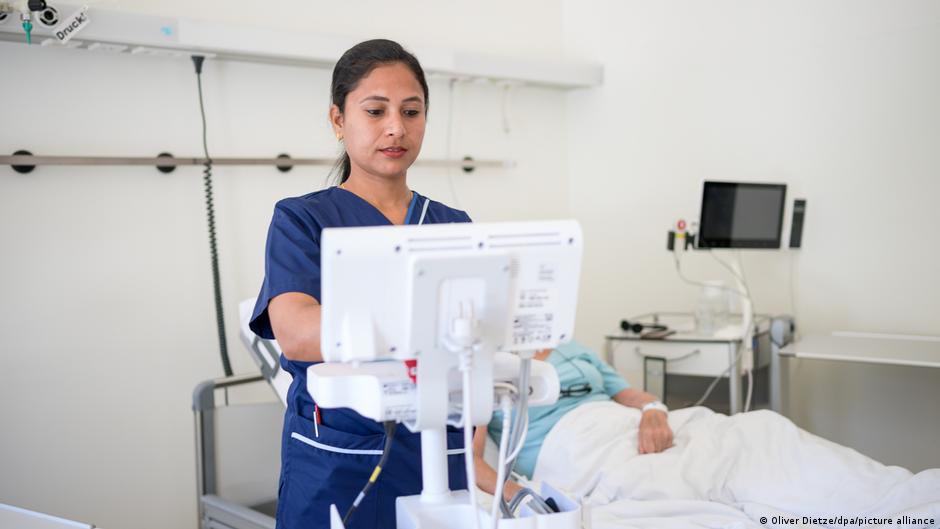
"They have six months to become fluent enough to work in Germany. Ramalakshi, one of the nurses, says her family struggled financially, but still managed to pay the equivalent of several thousand euros for her nursing college. Ever since completing her education, she felt the need to give back. "My aim is to work abroad," she told DW. "I want to settle my family financially, and I want to build my own house.""
"The government of the south Indian state of Tamil Nadu funds the language course to fight local unemployment and give disadvantaged families a shot at global opportunities. Private agencies then connect Indian nurses with potential employers. Workers needed Germany is desperate for skilled workers, as the country's so-called baby-boomer generation is retiring and leaving the workforce over the next few years, while too few are being born."
"Hospitals lack nurses, schools need teachers, and the IT sector is crying out for developers. Economists at the institute for labor market research (IAB) in Nuremberg, Germany, have estimated that Germany must attract 300,000 skilled workers annually just to maintain the status quo. Without them, Germans would have to work longer hours, retire later or simply be poorer, IAB researcher Michael Oberfichter told DW."
About 20 nurses in Chennai are undergoing intensive six-month German courses to qualify for work in Germany. The Tamil Nadu government funds the language training to reduce local unemployment and enable disadvantaged families to access international opportunities. Private agencies help place nurses with German employers. Germany faces acute shortages across health care, education and IT as large cohorts retire and birth rates stay low. Researchers at IAB estimate Germany needs roughly 300,000 skilled migrants annually to maintain current economic conditions. Without sufficient immigration, labor shortages could force longer working hours, delayed retirements, or reduced living standards.
Read at www.dw.com
Unable to calculate read time
Collection
[
|
...
]