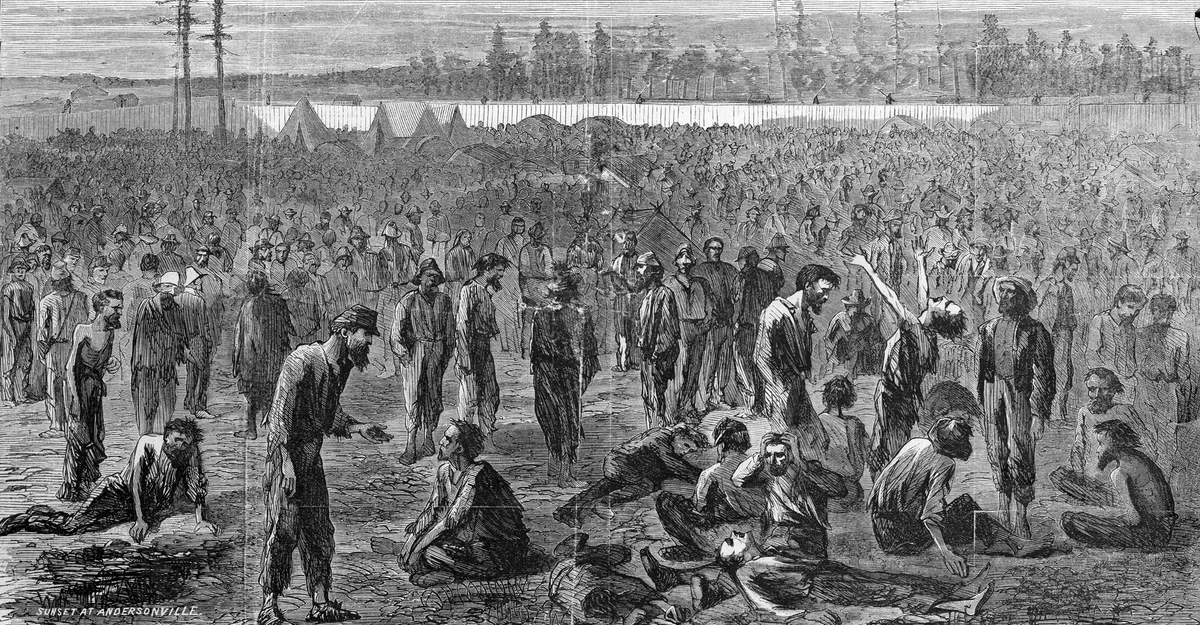
"But Brundage, who teaches at the University of North Carolina at Chapel Hill, does more than expand our understanding of a neglected aspect of Civil War history. His study offers a window into larger questions-about the evolution of laws of war and the definition of war crimes, about the ethical responsibility of combatants, about the growth of the nation-state and its attendant bureaucracy, and about the defining presence of race in the morality play of American history."
"Instead of the romantic version, a "good war" of courage and glory, that emerged in the conflict's immediate aftermath, or the post-civil-rights-era emphasis on the war as the vector of liberation for 4 million enslaved African Americans, a more recent direction has been labeled the "dark turn.""
"Grim rather than celebratory, it has chronicled the war's cost and cruelty, exploring subjects such as death, ruins, starvation, disease, atrocities, torture, amputations, and postwar trauma, as well as a freedom that was rapidly undermined."
The Civil War produced unprecedented prisoner suffering, with more than 400,000 men captured and at least half confined in what amounted to mass-incarceration sites. Camp conditions caused extreme mortality: starvation, disease, exposure, amputations, and torture, and left deep psychological and social wounds while undermining newly attained freedom. Capture rates far exceeded those of later wars, dramatically increasing human cost. The prisoner crisis prompted scrutiny of the evolution of laws of war and war-crime definitions, the ethical responsibility of combatants, the growth of bureaucratic state practices, and the central role of race in shaping treatment and memory.
Read at The Atlantic
Unable to calculate read time
Collection
[
|
...
]