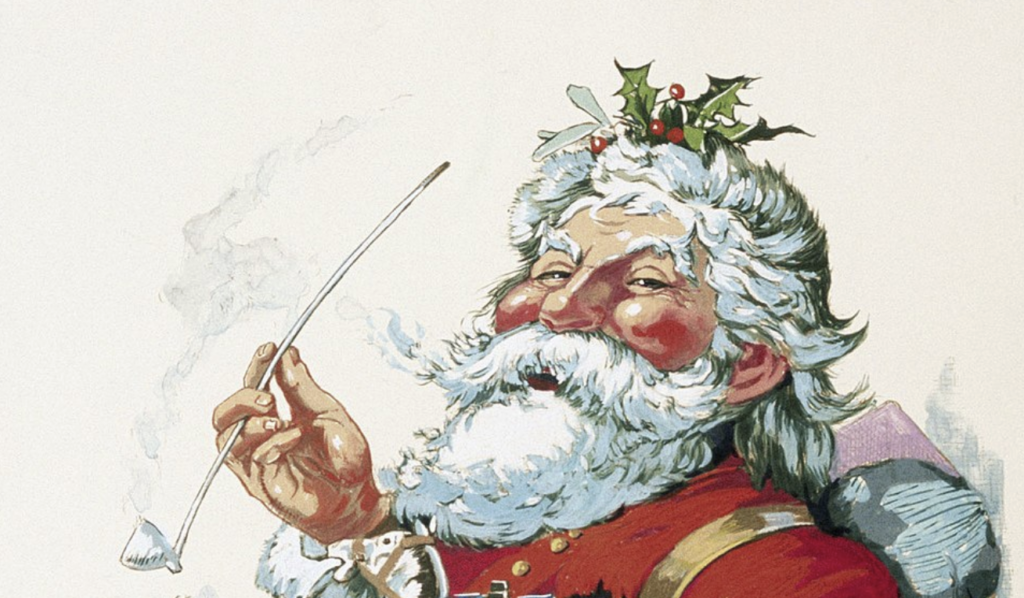
"It will no doubt come as a relief to many read­ers that San­ta Claus appears to have been a Union sup­port­er. We know this because he appears dis­trib­ut­ing gifts to sol­diers from that side of the Mason-Dixon in one of his ear­li­est depic­tions. That illus­tra­tion, "San­ta Claus in Camp" (above), first appeared in the Harper's Week­ly Christ­mas issue of 1862, when the Amer­i­can Civ­il War was still tear­ing its way through the coun­try."
"Its artist, a Bavar­i­an immi­grant named Thomas Nast, is now remem­bered for hav­ing first drawn the Demo­c­ra­t­ic Par­ty as a don­key and the Repub­li­can Par­ty as an ele­phant, but he also did more than any­one else to cre­ate the image of San­ta Claus rec­og­nized around the world today: more than Nor­man Rock­well, and more, even, than the Coca-Cola Com­pa­ny."
"San­ta Claus is an Angli­ciza­tion of Sin­terk­laas, a Dutch name for Saint Nicholas, who lived and died in what's now Turkey in the third and fourth cen­tu­ries, and who's been remem­bered since for his kind­ness to chil­dren. Few of us would rec­og­nize him in his por­trait from 1294 that is includ­ed in the Pub­lic Domain Review's pic­to­r­i­al his­to­ry of San­ta Claus, but with the pass­ing of the cen­turies, his images became mixed with those of oth­er fly­ing, win­ter-asso­ci­at­ed char­ac­ters from Ger­man­ic and Norse myth. In 1822, Clement Moore per­formed a defin­ing act of rhyming syn­the­sis with his poem "A Vis­it from St. Nicholas" (often called " 'Twas the Night Before Christ­mas"): in its vers­es we find the bun­dle of toys, the rosy cheeks, the white beard, the bel­ly shak­"
Santa Claus derives from Sinterklaas, the Dutch form of Saint Nicholas, a third- and fourth-century bishop famed for kindness to children. Over centuries, images of Saint Nicholas blended with Germanic and Norse winter figures. An 1822 rhymed composition introduced attributes such as a bundle of toys, rosy cheeks, a white beard, and a shaking belly. Thomas Nast, a Bavarian immigrant and illustrator, depicted Santa distributing gifts to Union soldiers in 1862 and helped codify the modern, red-coated, jolly Santa, exerting influence on later popular portrayals.
Read at Open Culture
Unable to calculate read time
Collection
[
|
...
]