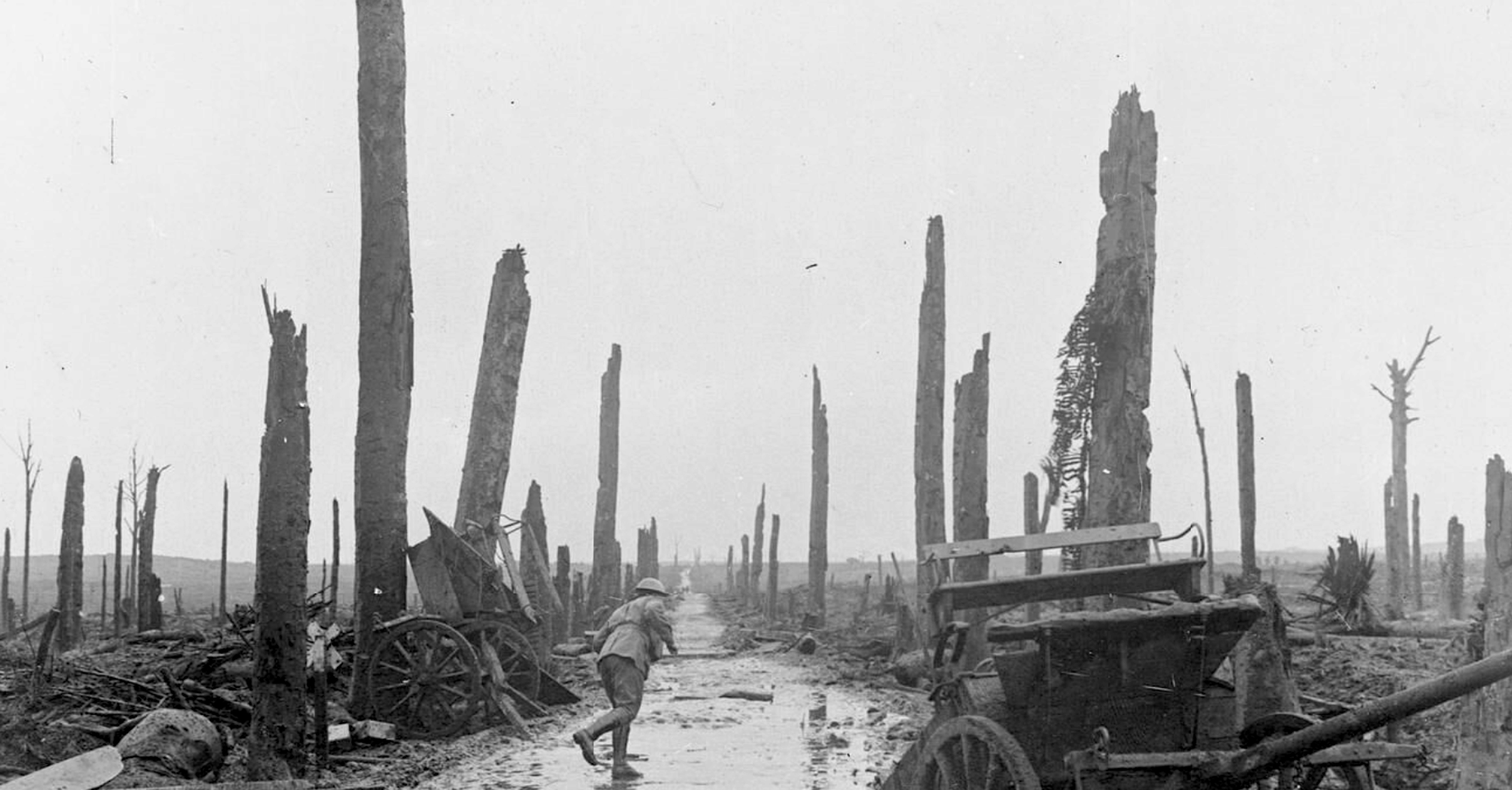
"The aim of the Allied commander in this part of the Western Front, Field Marshal Haig, was to break out of the Ypres salient and recapture key Belgian ports and a railway junction vital to the German Army. After unusually heavy and persistent rains, the battlefield turned into a horrific sea of mud and water-filled shell holes, which reduced the advance to just a few miles."
"WWI's Western Front saw German forces ranged against French, Belgian, and British armies. After the manic first six weeks of the war, when the Battle of the Frontiers and First Battle of the Marne saw great sweeping troop movements, the Western Front settled down to one of more or less static trench warfare. This front stretched from Ypres near the Belgian coast to the Swiss border in the south."
The Battle of Passchendaele (October–November 1917) was the final stage of the Third Battle of Ypres in Flanders, Belgium. Field Marshal Douglas Haig aimed to break out of the Ypres salient and to recapture Belgian ports and a railway junction vital to the German Army. Unusually heavy and persistent rains turned the battlefield into mud and water-filled shell holes that crippled movement and reduced advances to only a few miles. British and British Empire forces suffered over 250,000 casualties while achieving no significant strategic gain. The Western Front had largely become static trench warfare after earlier large battles.
Read at World History Encyclopedia
Unable to calculate read time
Collection
[
|
...
]