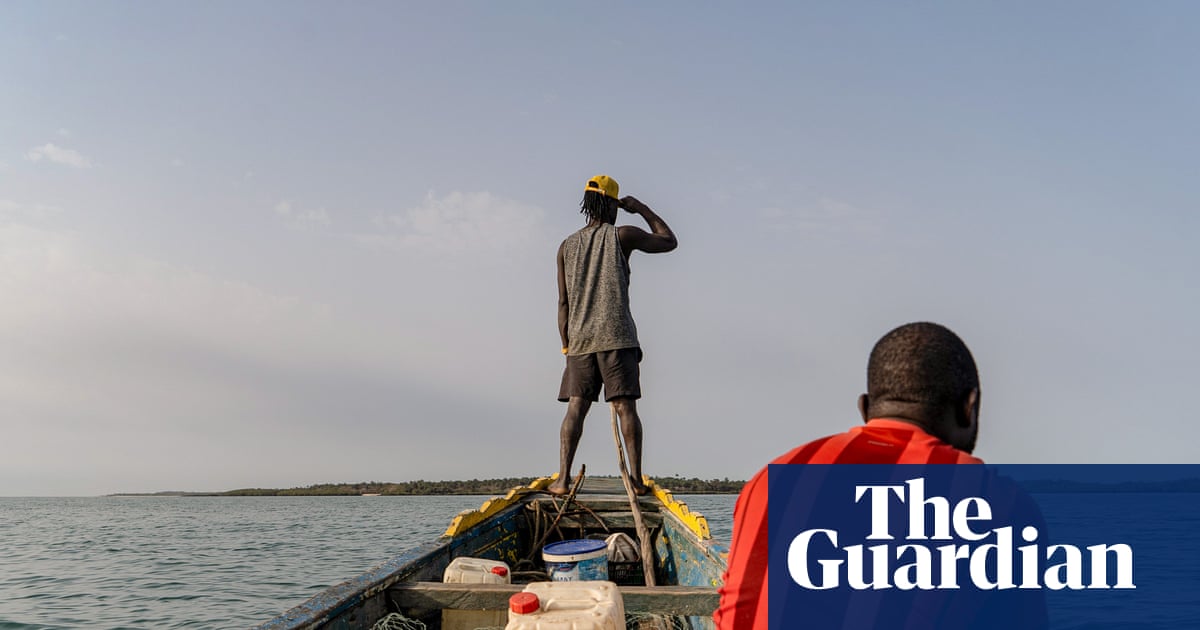
"The machines have been broken for months, Pereira says, as he pulls in his nets on the shore of the island inside the protected Bijagos archipelago. We've alerted the ministry of fisheries, but so far, no one has come to fix them. Wooden canoes are the only fishing boats allowed among the cluster of 88 islands that make up the archipelago."
"Its sandbars are a nursery for countless species, leading some scientists to refer to it as the Galapagos of west Africa for its populations of endangered turtles and manatees. It is also why the area has been designated as protected from everything but small-scale fishing."
"Like Pereira, many of these creatures in this area rely on sardinella, a small oily fish. It is a vital food source for migratory birds such as terns that winter in Bijagos in their tens of thousands, as well as for barracudas and jacks, and whales and dolphins further out to sea."
"Among the vessels circulating here in 2025 was the Hua Xin 17. At 125 metres, it is longer than a football field. It is listed as a cargo ship in maritime databases, but a new investigation by the Guardian and DeSmog can reveal that the Chinese-owned boat is in fact a floating"
The Bijagos archipelago in Guinea-Bissau, designated as a marine protected area and referred to as the Galapagos of west Africa, faces threats from illegal industrial fishing. Local fishers like Pedro Luis Pereira rely on small-scale wooden canoe fishing for sardinella, a vital food source for migratory birds, marine mammals, and endangered species. Infrastructure failures, such as broken ice factories, compound challenges for local communities. Industrial vessels, including the Chinese-owned Hua Xin 17, operate at the boundaries of the protected area, exploiting sardinella stocks despite regulations prohibiting their entry. This illegal activity undermines both local livelihoods and the conservation of the archipelago's unique biodiversity.
#illegal-industrial-fishing #marine-protected-areas #guinea-bissau-fisheries #biodiversity-conservation #small-scale-fishing
Read at www.theguardian.com
Unable to calculate read time
Collection
[
|
...
]