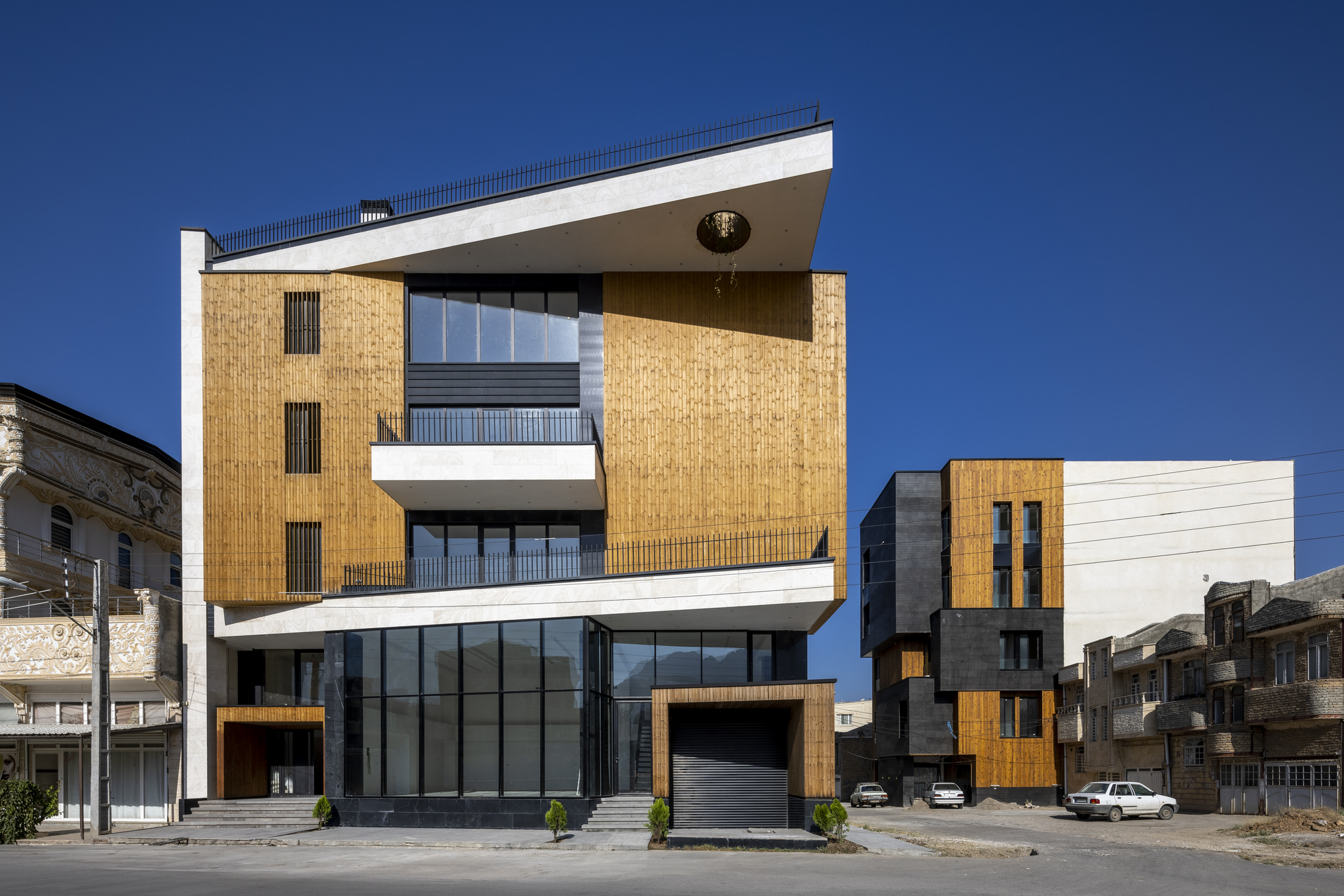
"Ramand is, before being a project, a decision—a decision about how a cube can stand on a dual-cornered site without compromising its own geometry and without disregarding the city. The wooden volume is a controlled rotation, neither a formal gesture nor an exaggeration; merely the minimal deviation required for the form to settle into the site."
"The wooden skin is not an emotional choice, but a means to soften the hard cube. In a site surrounded by schools, the wood transforms potential seriousness into a conversational tone, aware of the daily gaze of children building their spatial memory."
Ramand represents a deliberate architectural decision addressing how a cubic volume can occupy a challenging dual-cornered site while maintaining its geometric integrity and respecting the surrounding urban context. The wooden structure undergoes a controlled rotation—a minimal deviation rather than a formal gesture—allowing the form to settle naturally into the site without imposing itself on the city. The wooden skin serves a functional purpose beyond aesthetics, softening the inherent hardness of the cube's geometry. Positioned in an area surrounded by schools, the material choice transforms the building's potential severity into an approachable, conversational character that acknowledges the daily spatial perception of children developing their environmental awareness.
#geometric-rotation #material-strategy #urban-integration #child-centered-design #wooden-architecture
Read at ArchDaily
Unable to calculate read time
Collection
[
|
...
]