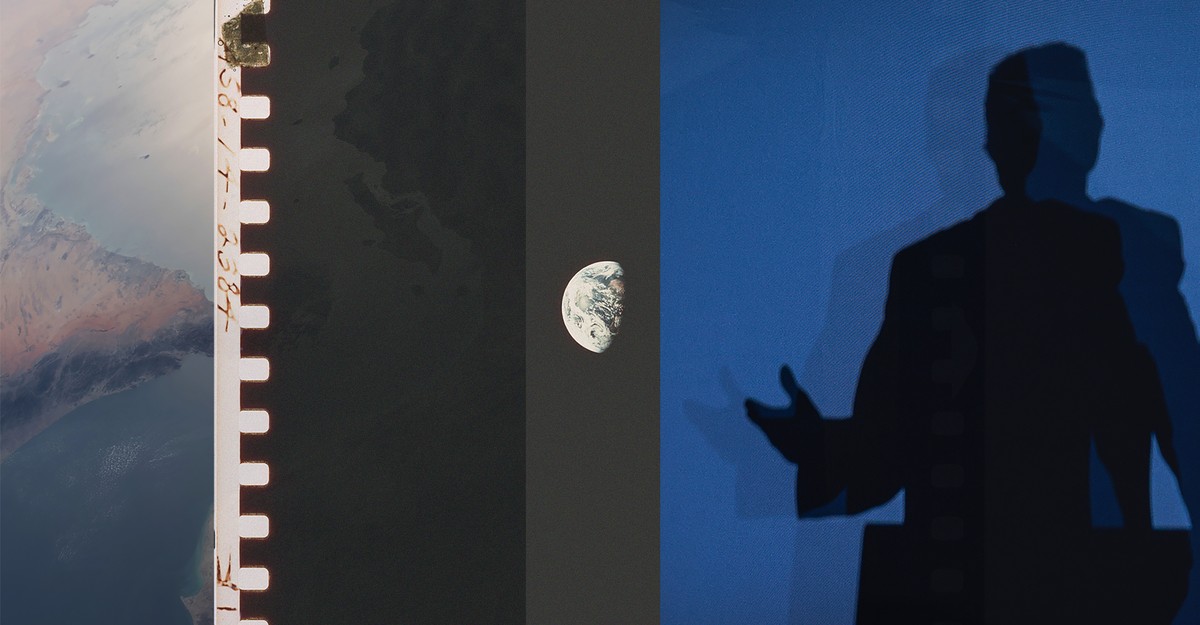
""You don't see borders, you don't see religious lines, you don't see political boundaries. All you see is Earth, and you see that we are way more alike than we are different," Christina Koch, one of the four astronauts on the Artemis II mission, told NASA recently."
"Jim Lovell, describing the view on Apollo 8 from the dark side of the moon back in the late 1960s, told Chicago magazine that he could put his thumb up to the window, and in that moment, 'everything I ever knew was behind it. Billions of people. Oceans. Mountains. Deserts. And I began to wonder, where do I fit into what I see?'."
"William Shatner has written that his brief experience looking at the Earth produced a profound sadness. 'What I was feeling was grief, and the grief was for the Earth,' he told Koren in 2022."
"Marina Koren previously reported in this magazine that, upon seeing the Earth from space, one astronaut 'became absolutely convinced we would kill ourselves off between 500 and 1,000 years from now.'"
The overview effect profoundly impacts those who view Earth from space, fostering a sense of unity and shared humanity. Astronauts describe seeing the planet without borders or divisions, emphasizing commonalities over differences. This perspective can evoke deep emotional responses, ranging from awe to despair. Some astronauts express concerns about Earth's fragility and future, while others feel a sense of grief for the planet. Recent images from NASA's Artemis II mission continue to evoke these powerful emotions, highlighting the beauty and vulnerability of Earth.
Read at The Atlantic
Unable to calculate read time
Collection
[
|
...
]