Poison frog tadpoles communicate with parents using vibrations rather than vocalizations. Parents assess offspring hunger by sensing these vibrations and respond with specific care behaviors. In some species, fathers place tadpoles into separate small water pools and patrol them daily. When a father detects tadpole vibration, he repeatedly vocalizes to attract the mother. The mother also senses the tadpole’s jiggling and determines whether to lay an unfertilized egg for the tadpole to consume. Researchers still do not know how vibration patterns translate into parental decisions. A hard-of-hearing scientist used touch-based communication experience to study the mechanism, building a vibration-mimicking robot with engineers to decode the signals and improve scientific collaboration.
"When the tadpoles of some poison frogs talk to their parents, they don't croak or sing. Instead, they speak in a language of vibration, performing a wriggling dance against their mother's or father's body. The parents somehow judge their offspring's hunger from this vibration."
"In many species, fathers give their newly hatched tadpoles piggybacks to pools of water, such as rainwater cupped in a leaf. A mimic poison frog (Ranitomeya imitator) father puts each of its 2-4 tadpoles in a separate pool and patrols the pools daily. If he stands in the water and feels a tadpole vibrating, he sings relentlessly to his mate until she comes to join him."
"The mother feels the tadpole's jiggling for herself and decides whether she needs to lay an unfertilized egg for it to eat. To try to decode a family's conversation, Goolsby teamed up with Stanford engineers and built a one-of-a-kind robot that mimics a tadpole's vibrations. Her project has begun to unlock the secrets of an amphibian language."
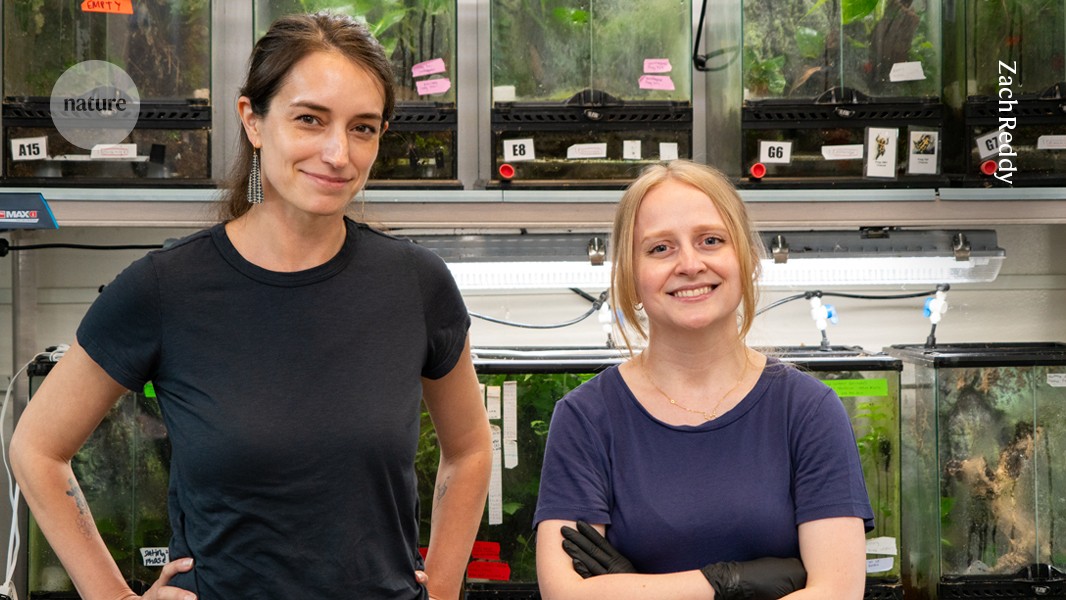
"Scientists don't yet know exactly how the tadpole vibrations translate into parental marching orders. But when Billie Goolsby started her PhD research at Stanford University in California in 2020, she felt uniquely equipped to investigate the question. Goolsby was born hard of hearing, and her mother spoke to her using a language that, like the amphibians' communication, included touch."
#animal-communication #poison-frogs #parent-offspring-interaction #vibration-signaling #behavioral-ecology
Read at Nature
Unable to calculate read time
Collection
[
|
...
]