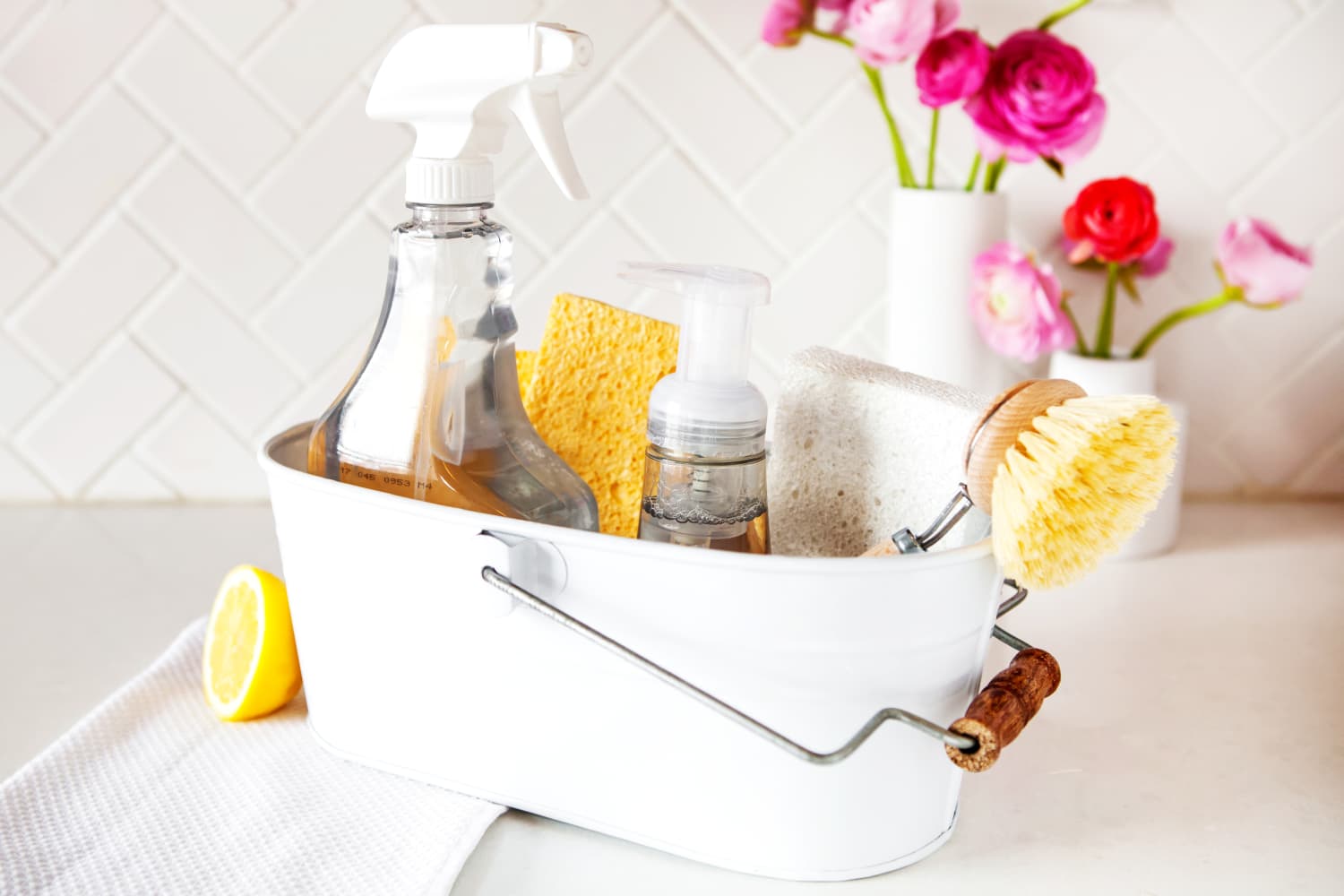
"In one of my first restaurant jobs (I've had many), I remember seeing a mop bucket with multiple sections: one for cleaning water, one for sanitizing, and one (occasionally used) for disinfecting. As someone who'd never really mopped before, I couldn't understand why we needed anything more than one bucket of soapy water. How naive! At the time, I didn't really know the difference between cleaning, sanitizing, and disinfecting - and I know I'm not alone. Here's how cleaning pros break it down, plus when to use each one at home."
"Cleaning is the first step, and the "lowest level" of dealing with a mess. "Cleaning just means to remove soil or dirt from a surface," says Jhon LeBaron, co-owner of Primavera Cleaning Service. "There is actually no definition of how clean is clean." Because cleaning products aren't regulated by the Environmental Protection Agency (EPA), labels can be full of vague promises like "powers through," "attacks dirt," "professional strength," and "deep-clean technology," LeBaron explains. Don't let that marketing convince you that a regular cleaner is sanitizing or disinfecting, unless it explicitly says so."
"No matter what your next step is, you'll always want to clean the surface first. If you skip this part, a sanitizer or disinfectant can only reach the grime sitting on top. Clearing away crumbs, grease, and visible grime makes every step after this more effective (and a lot easier). Sanitizing is a step up from cleaning. "It means you're using a sanitizing product to reduce bacteria on a surface to a number that's considered safe or acceptable by public health standards," says Melissa Lush, cofounder of Force of Nature. "In other words, there is not a specific threshold like there is with disinfec"
Cleaning removes visible soil and grime from surfaces and is the essential first step before any sanitizer or disinfectant. Cleaning-product labels can be vague because cleaning formulations are not regulated by the EPA, so label language does not imply sanitizing or disinfecting power unless explicitly stated. Sanitizing uses products to reduce bacteria on a surface to levels considered safe or acceptable by public health standards and does not have the same specific threshold as disinfecting. Clearing crumbs, grease, and visible grime makes sanitizing or disinfecting more effective and easier to achieve.
Read at Apartment Therapy
Unable to calculate read time
Collection
[
|
...
]