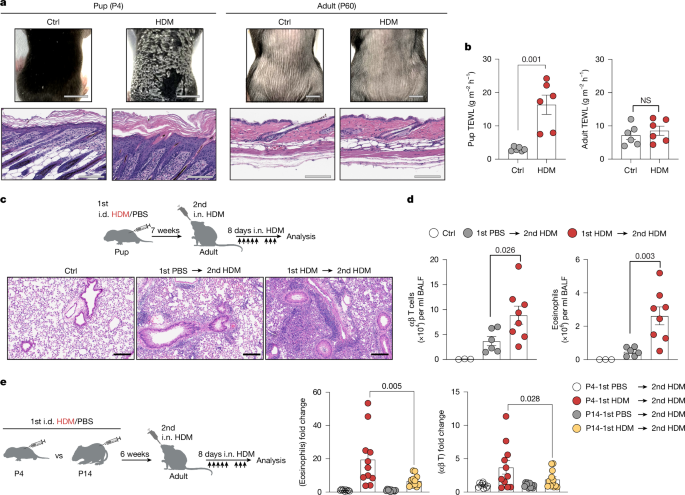
"In early life, exposure to common allergens triggers a distinct bifurcated immune response, simultaneously triggering type 17 inflammation in the skin and initiating canonical T helper 2 sensitization in the lymph nodes. This early-life type 17-mediated dermatitis primes the exaggerated allergic lung inflammation upon secondary allergen exposure."
"CD301b+ conventional type 2 DCs acquire allergen, adopt the pii-DC state, produce IL-23 and activate local type 17 cells independently of lymph-node engagement. The pii-DC state is enabled by the immature hypothalamic-pituitary axis, representing a distinct developmental mechanism governing early-life immune responses to allergens."
Early-life exposure to common allergens initiates distinct immune mechanisms that differ from adult responses. Allergen exposure simultaneously triggers type 17 inflammation directly in the skin and canonical T helper 2 sensitization in lymph nodes. The early-life type 17-mediated dermatitis subsequently primes exaggerated allergic lung inflammation upon secondary allergen exposure. Dendritic cells, specifically CD301b+ conventional type 2 DCs, acquire allergen in the skin and adopt a peripheral immune inducer state, producing IL-23 and activating local type 17 cells without requiring lymph node migration. This age-dependent mechanism explains why allergic diseases frequently emerge early in life and establishes the foundational immune pathways governing allergen responses during development.
#early-life-allergen-immunity #dendritic-cell-mechanisms #type-17-inflammation #allergic-disease-development #age-dependent-immune-responses
Read at www.nature.com
Unable to calculate read time
Collection
[
|
...
]