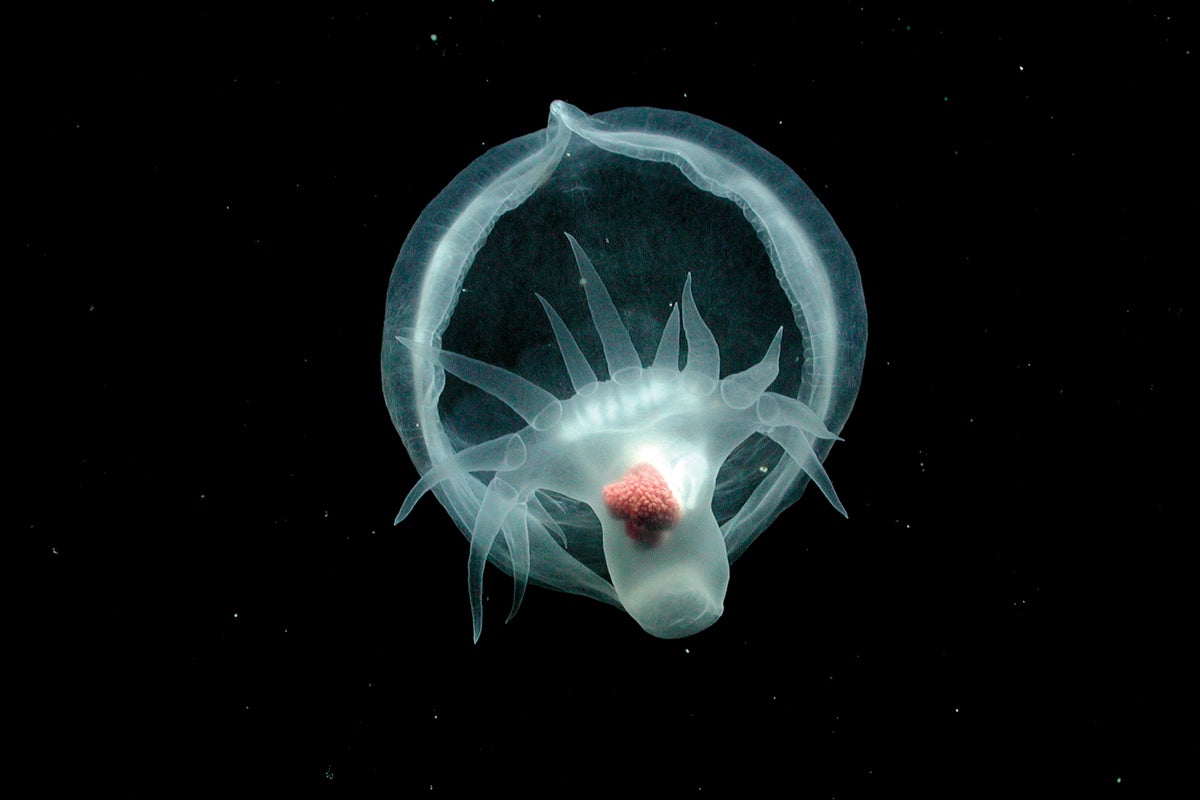
"For more than two decades, scientists at California's Monterey Bay Aquarium Research Institute have occasionally spotted a little translucent creature in the ocean's midnight zone. The gelatinous blob uses a hood surrounding its head to catch prey and has detachable tentacles; its hood and tail are decorated with glowing blue-green dots. This year, scientists finally figured out what it isthe mystery mollusk is actually a nudibranch, or sea slug. In fact, it's from an entirely new family of nudibranchs and has been dubbed Bathydevius caudactylus."
"People have known about colossal squids for 100 years, but these enigmatic ocean denizenswhich can grow to 23 feet in lengthhad never been observed in their natural habitat. That changed this year when Schmidt Ocean Institute scientists captured the first video of one about 2,000 feet below the ocean's surface in the remote South Atlantic Ocean. This particular squid wasn't so colossal, thoughit was a baby measuring only about one foot in length."
"A large sponge, a cluster of anemones, and other life is seen nearly 230 meters deep at an area of the seabed that was very recently covered by the George VI Ice Shelf in Antarctica. Sponges can grow very slowly, sometimes less than two centimeters a year, so the size of this specimen suggests this community has been active for decades,"
Numerous unusual deep-sea organisms were observed, including a newly identified nudibranch family named Bathydevius caudactylus. The translucent gelatinous creature uses a hood to catch prey and has detachable tentacles decorated with glowing blue-green dots. For the first time, scientists recorded a colossal squid in its natural habitat about 2,000 feet below the surface; that individual was a juvenile about one foot long. Antarctic seabed surveys revealed sponges, anemones, and other life nearly 230 meters deep in areas recently uncovered by the George VI Ice Shelf, indicating seabed communities that have persisted for decades due to slow sponge growth.
Read at www.scientificamerican.com
Unable to calculate read time
Collection
[
|
...
]