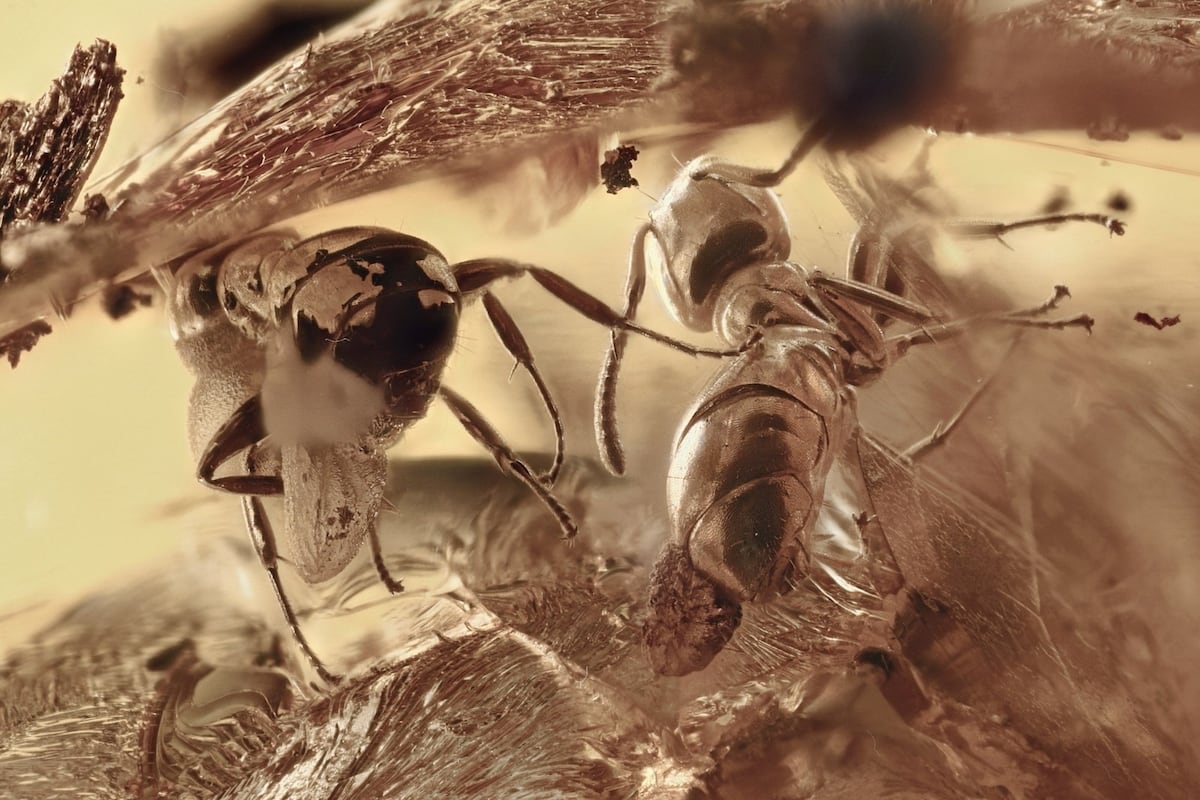
"Although there are many amber stones containing a single creature, there are fewer that include two or more, as is the case with a pair of mosquitoes trapped in amber 130 million years ago which tell us that, back then, males also sucked blood. Even more extraordinary is when several organisms can be seen interacting, either eating the other, acting as a parasite, or cooperating."
"Amber is an organic stone that began as a vegetable resin. Many trees, such as conifers, produce it to heal their wounds, such as tears in their trunks and branches. As its pours down the trunk, it drags with it twigs, leaves and even flowers. Small living beings are also trapped by this sticky substance."
"When the substance falls into a water tank or is buried, a polymerization process begins that turns it into copal, an aromatic substance, that is more translucent, and that over hundreds of thousands of years ends up mineralizing completely. It is used not only in art and jewelry, but also for the study of fossil ecosystems thanks to the organisms trapped during the formation of amber."
Amber, formed from tree resin, preserves ancient organisms and their interactions with exceptional clarity. While single-organism amber specimens are common, multi-organism examples are rare and scientifically valuable. These specimens document prehistoric behaviors including predation, parasitism, and cooperation. A recent scientific journal edition examined six amber stones containing interactive scenes from millions of years ago. Amber forms when tree resin hardens and undergoes polymerization into copal, eventually mineralizing completely. The resin traps various organisms including arthropods, snails, and worms as it flows down tree trunks. These preserved ecosystems provide crucial insights into ancient life and species relationships.
Read at english.elpais.com
Unable to calculate read time
Collection
[
|
...
]