"Because I am one of very few specialists in Laos, some people have started to describe me as the country's first national herpetologist. This is accurate to my knowledge; I'm not aware of any other Laotians who were working in the field here before 2007, when I started my master's degree. Conservation studies were instead almost always done by visiting foreign scientists. My PhD challenged that trend, however: I focused on the diversity of Tylototriton salamanders, which led to the discovery of four species."
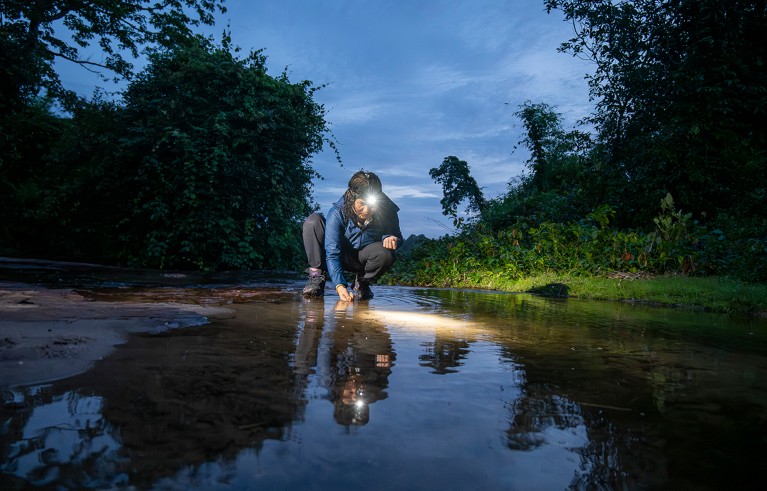
"My day-to-day responsibilities at the National University of Laos in Vientiane include giving lectures, conducting research, leading studies, training future biologists and contributing to conservation initiatives. My own research focuses on amphibian and reptile diversity, with an emphasis on conserving threatened species in the country. In this photograph, I'm surveying a population of Fejervarya limnocharis frogs along a stream outside Vientiane, for a field survey. I'm recording the number of adults, tadpoles, eggs and frog calls, as well as tracking other ecological factors."
The individual is one of very few specialists in Laos and is described as the country's first national herpetologist. No other Laotians worked in the field before 2007, when master's studies began. Conservation studies were almost always conducted by visiting foreign scientists. A PhD focused on the diversity of Tylototriton salamanders led to the discovery of four species. Day-to-day responsibilities at the National University of Laos in Vientiane include lectures, research, leading studies, training future biologists and contributing to conservation initiatives. Research focuses on amphibian and reptile diversity with emphasis on conserving threatened species. Field surveys include monitoring Fejervarya limnocharis populations and recording adults, tadpoles, eggs, calls and ecological factors.
Read at Nature
Unable to calculate read time
Collection
[
|
...
]