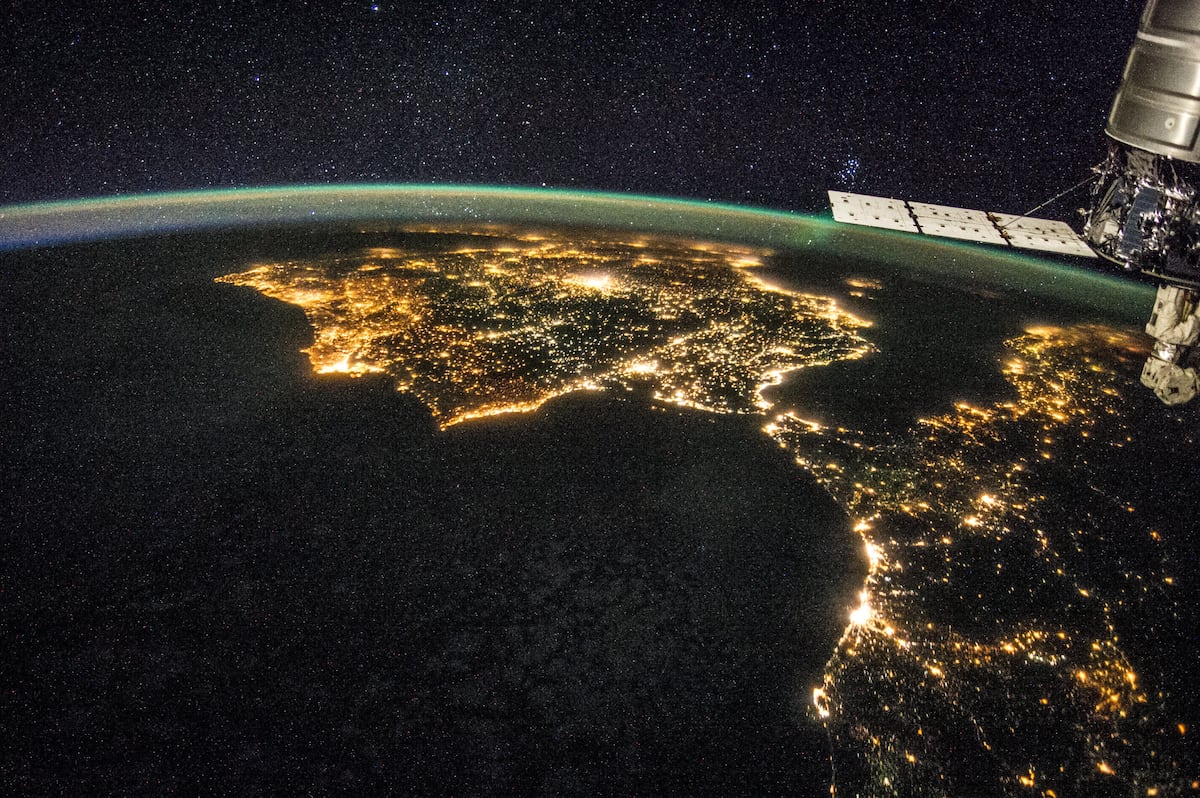
"The Earth's crust is fractured into portions that float and move on a nearly liquid and ductile lower mantle. This movement of tectonic plates is what causes continents to move closer together or farther apart, and seas to close or open. But it is also responsible for tensions that are eventually released in the form of earthquakes and volcanic eruptions."
"Hundreds of thousands of years from now, perhaps millions, the Andalusian coast will face west or will have merged with North Africa. The very long-term consequences will be enormous: the Mediterranean will once again become a closed sea, Africa and Europe will be joined to the west, and what is now southern Iberia will either face the Americas or will have merged with the area of Ceuta, a Spanish exclave in North Africa."
The Iberian Peninsula and North Africa are converging due to ongoing plate tectonic motion. Iberia is rotating clockwise from east to west, producing westward displacement and incremental compression across the Strait of Gibraltar at rates of roughly 4–6 millimeters per year. Plate boundaries near the Atlantic and Algeria are well defined, while the boundary south of Iberia is diffuse and structurally complex. Continued convergence generates seismic and volcanic activity as accumulated tension is released. Over hundreds of thousands to millions of years, the Mediterranean is expected to close, Africa and Europe will fuse in the west, and southern Iberia may face the Americas or merge with Ceuta.
Read at english.elpais.com
Unable to calculate read time
Collection
[
|
...
]