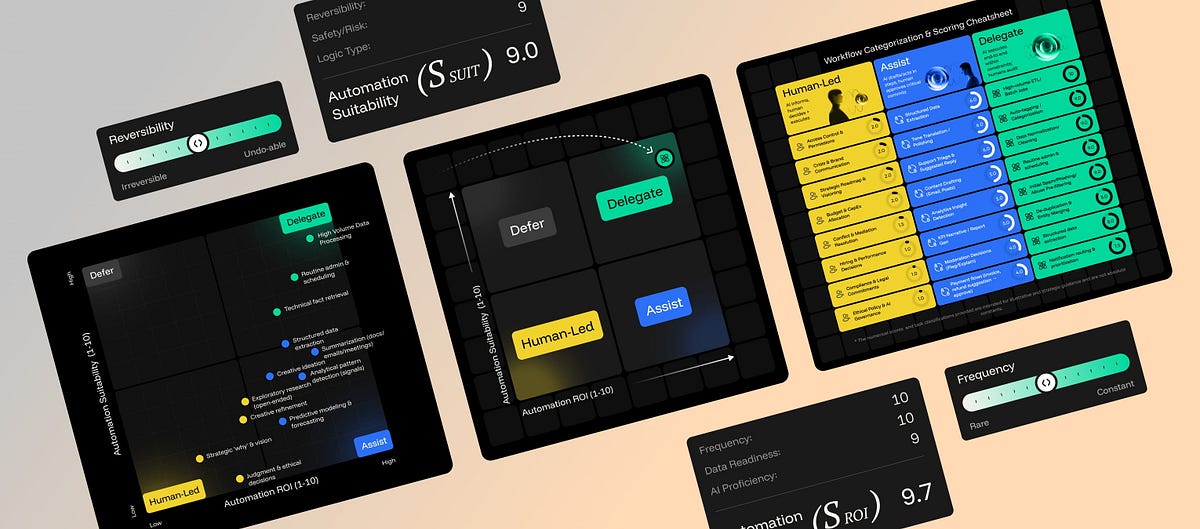
"For years, application design followed a straightforward goal: reduce friction so users can complete their jobs faster. We mapped flows, removed steps, and optimized interactions - assuming the user would remain the primary actor. Today, we find ourselves in a dangerous "messy middle." We are building software that can act, decide, and synthesize, yet we are still designing it as if it were a simple tool. If we want to build products people actually love, we have to stop "sprinkling" AI onto our workflows. We have to answer one fundamental question: Who holds the steering wheel at this specific moment, and what is the logic that justifies it?"
"The human retains full control. AI's role is to surface evidence, highlight tradeoffs, and structure the decision - but never to act. The human reads, weighs, chooses, and executes. Design goal: Improve decision quality and accountability by giving the human clear evidence, tradeoffs, and structured rationale support. When to use it: High-stakes decisions requiring subjective judgment, empathy, or ethical nuance, or where the process itself creates value. Common UX patterns Evidence packs (relevant facts, sources, prior cases, policies) Tradeoff framing (pros/cons, risks, alternatives)"
"We need a systematic way to move beyond "assistance everywhere." We need to know when to step back and let the machine take the wheel entirely, and when to protect the human's role as the accountable driver. This article provides a practical framework that turns the "who does what" decision into a repeatable process."
AI capabilities shift product design from simple tools to entities that can act, decide, and synthesize, creating a need to assign control per moment. A practical scoring model maps each task to one of three modes: Human-Led, Assist, or Delegate. Human-Led preserves full human control while AI surfaces evidence, frames tradeoffs, and structures rationale. Assist speeds execution and offers suggestions while keeping humans accountable. Delegate lets the system act autonomously for low-risk, repeatable tasks with measurable outcomes. Interfaces must enforce the chosen mode through transparency, clear accountability, and appropriate UX patterns.
Read at Medium
Unable to calculate read time
Collection
[
|
...
]