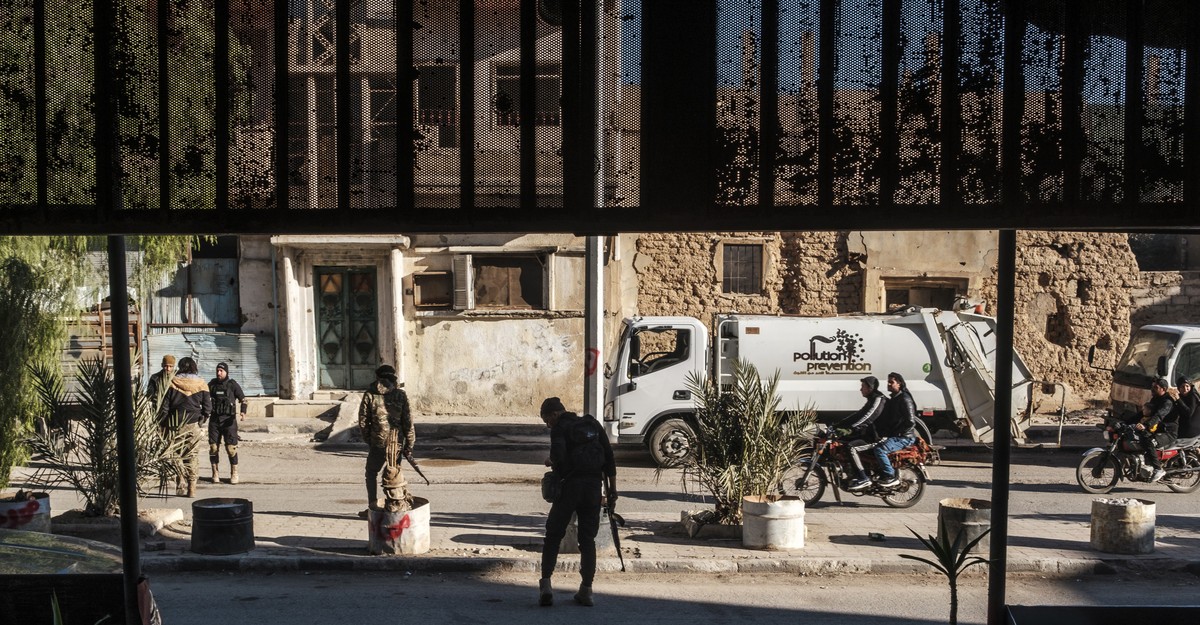
"Last Saturday, an Islamic State infiltrator ambushed a meeting between American soldiers and their local counterparts in a Syrian desert town. Two members of the Iowa National Guard and a U.S. civilian interpreter were killed in the assault-whose perpetrator may or may not have known that the subject of the meeting was how to counter ISIS. The incident didn't just illustrate the danger of extremists hiding within Syria's new security forces."
"had 30,000 soldiers at his command when he toppled the dictatorship of Bashar al-Assad a year ago-a small fraction of what he needed to control all of Syria. Since then, he has been directing a state-building effort that would be daunting even if his country were not destitute and littered with rubble. He must recruit and vet tens of thousands of new security forces into a new government whose leaders once espoused an ISIS-style militancy, but are now committed to overcoming it."
An Islamic State infiltrator ambushed a meeting between American soldiers and local counterparts in a Syrian desert town, killing two Iowa National Guard members and a U.S. civilian interpreter. The attacker may not have known the meeting focused on countering ISIS. Extremists can hide within newly formed Syrian security forces, and outside the capital there remains virtually no functioning state. State-building faces major obstacles including poverty, social and religious divisions, and foreign interference, which could delay recovery for decades. Palmyra exemplifies these limits: moribund economy, thin government presence, loosely patrolled roads, and recent population movements that ease extremist infiltration.
Read at The Atlantic
Unable to calculate read time
Collection
[
|
...
]