"The renovation began with the exterior, which was repainted in black. The entrance door and window frames were finished in the same tone to establish a cohesive facade. The intervention aimed to unify the appearance of the building while retaining its original form. Inside, the entrance preserves a distinctive original detail: a narrow strip of smooth white pebbles set between reddish floor tiles and a concrete step. The pebbles remain loose, introducing a subtle tactile quality."
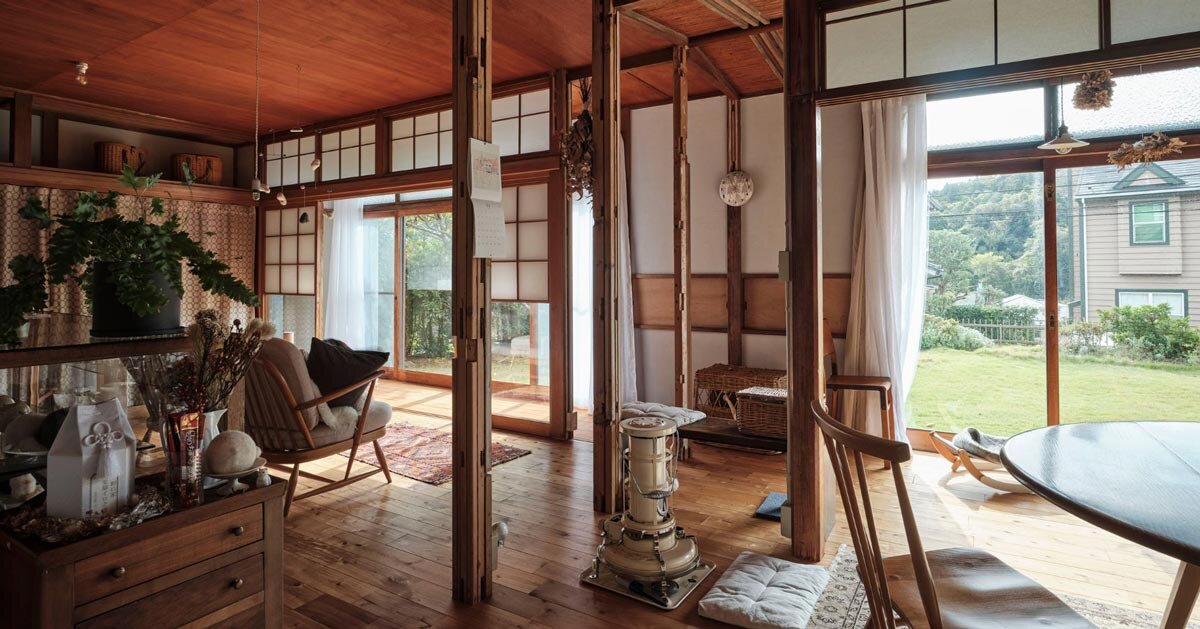
"On the ground floor, the design team at ROOVICE converts the front room into a studio and office. Original glass sliding doors from the built-in storage were repaired and retained as functional and visual features. At the rear, two garden-facing rooms were combined to form a single living area. Large windows provide daylight and establish a visual connection to the garden. Along the engawa corridor, shoji-lined walls were preserved, as were the original ceiling boards."
Kajiwara House underwent a careful renovation that prioritized retaining the 1960s timber framework and original proportions while improving usability. Exterior surfaces were unified by repainting the facade black and matching entrance door and window frames. Interior interventions preserved distinctive details such as a loose strip of white pebbles at the entrance and repaired original glass sliding doors. Aging wall panels were replaced and a simple wooden fence was added to contain cats. Ground-floor spaces were reconfigured to create a studio and a combined living area with large garden-facing windows, continuous flooring, preserved shoji walls and ceiling boards. The bathroom was slightly enlarged and original tiles were preserved where possible, with replacements used when matches were unavailable.
Read at designboom | architecture & design magazine
Unable to calculate read time
Collection
[
|
...
]