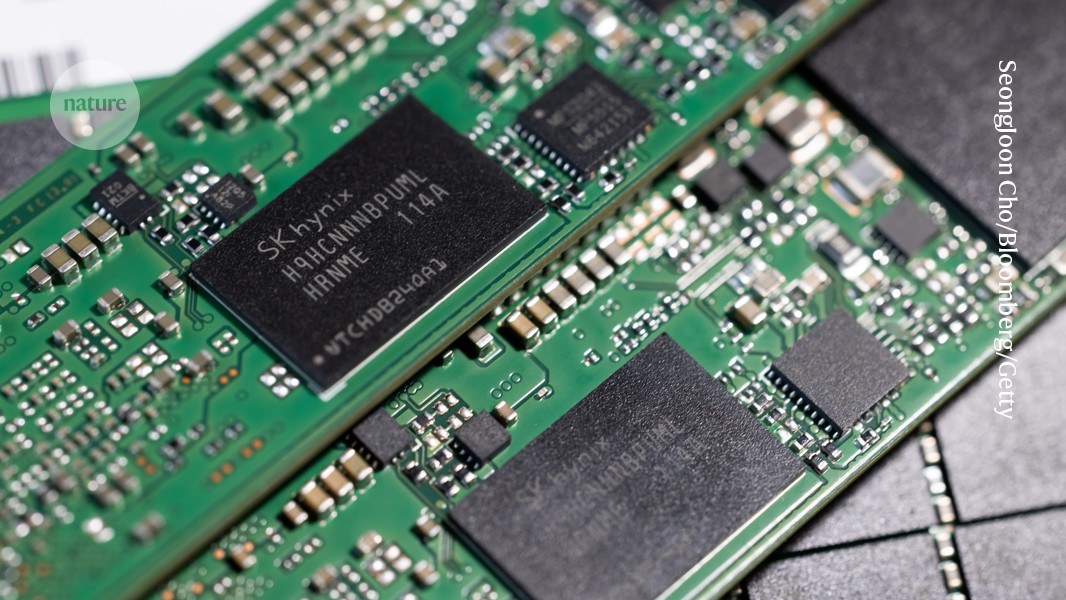
"Scientific research increasingly relies on large-scale computing infrastructure, and many of these workloads require substantial memory capacity. The shortage is driven by the rise of artificial-intelligence systems, which has created a voracious demand for high-speed memory chips, causing some forms of RAM to triple in price over 2025."
"RAM chips help to provide short-term storage for data that are actively in use, allowing a computer's processor to quickly access the information it needs. AI uses more complex memory chips than those found in personal computers, and surging demand has pushed manufacturers to shift most of their production to the high-capacity ones needed to train AI models."
"Memory now accounts for more than one-third of the cost of building a computer, up from about 15% just a few months ago. Even with the shift in production to high-capacity chips, there is still not enough of the complex memory necessary for training AI to meet demand, and it could take manufacturers 18 months or more to ramp up supply."
A severe RAM chip shortage, termed RAMmageddon, is expected to persist through 2027, driven by surging demand from artificial intelligence systems. Video gamers and scientists alike face challenges as prices have tripled for certain RAM types in 2025. Manufacturers have shifted production toward high-capacity memory chips needed for AI model training, leaving standard chips scarce. Memory now comprises over one-third of computer building costs, up from 15% months earlier. Resource-constrained laboratories struggle to access powerful computing tools, prompting researchers to develop more efficient algorithms and hardware to reduce memory requirements. Supply constraints may persist for 18 months or longer as manufacturers work to meet enormous demand.
#ram-shortage #artificial-intelligence #computing-infrastructure #memory-chip-crisis #scientific-research
Read at Nature
Unable to calculate read time
Collection
[
|
...
]