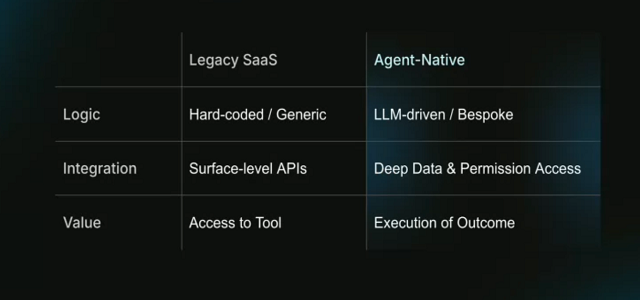
"“you can no longer expect ‘a single agent that can be built once, sold ten thousand times, and just operate perfectly.’ Every organization has its own operational nuances, and agents must be trained within those environments.”"
"“SaaS products were designed to work for as many customers as possible. Even when customizable, they required organizations to adapt to the system. Employees learned how Salesforce worked. They learned how Jira structured tickets. The software defined the workflow.”"
"“Instead of configuring software, companies are increasingly training agents. Rather than teaching employees how to navigate a UI, organizations teach AI systems how decisions are made, how exceptions are handled, and how internal processes flow from start to finish.”"
"“This fundamentally changes the economics of software. SaaS thrived on standardization. Agentic AI thrives on customization. In the emerging Agentic AI vs SaaS landscape, differentiation shifts from feature breadth to contextual depth.”"
SaaS has long relied on building software once, distributing it over the internet, charging per seat, and scaling predictably. Agentic AI changes the underlying assumptions by making intelligence dynamic, personalized, and integrated into enterprise systems. SaaS products were designed to fit many customers, requiring organizations to adapt to the software’s UI-driven workflows. Agentic systems instead require training within each organization’s operational environment, including how decisions are made, how exceptions are handled, and how internal processes flow end to end. As a result, software economics move from standardization toward customization, and differentiation shifts from feature breadth to contextual depth.
Read at Medium
Unable to calculate read time
Collection
[
|
...
]