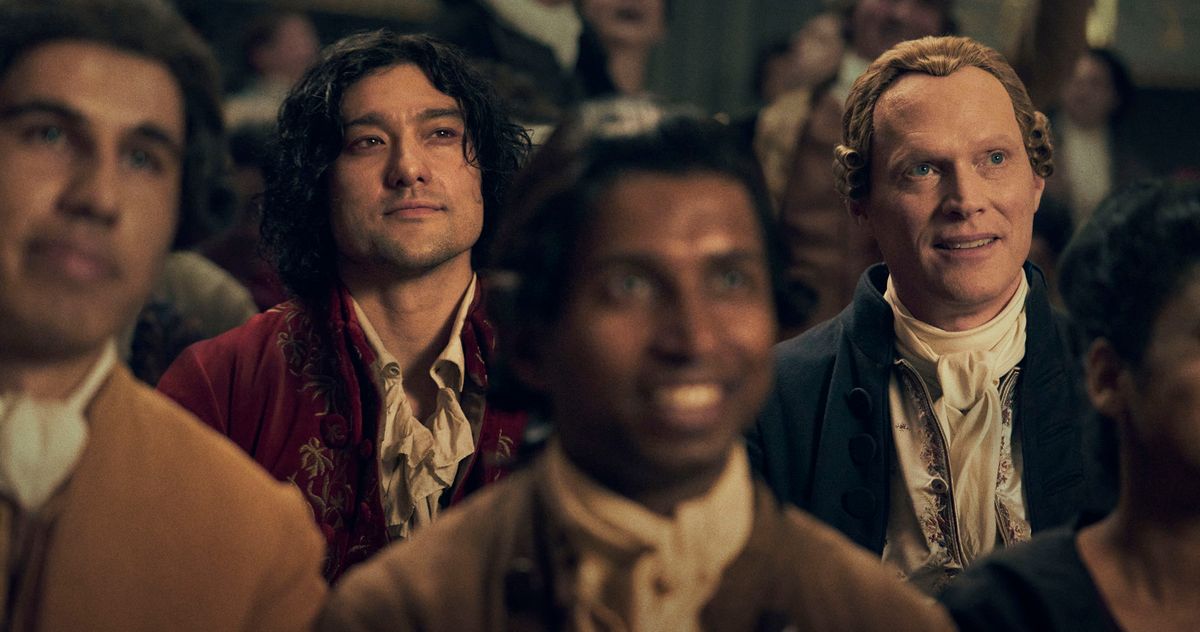
"Sitting askew in a church pew with a sneer affixed on his face, Salieri seems like he's about to list a litany of complaints to, presumably, Wolfgang Amadeus Mozart (Will Sharpe), the wunderkind who has upstaged Salieri, and whose infant son's death inspired the funeral mass Salieri just attended. Then the scene's perspective shifts, and Amadeus reveals that Salieri's look of disgust is not for his younger rival but for the figure of Jesus Christ hanging on a cross above the sanctuary."
""You give me just enough talent to know how little I truly possess," Salieri weeps, and then he composes himself. "From this time on, we are enemies, you and I," he promises to God, with such a mixture of conviction and revulsion that it's clear he'll do anything to fulfill his next vow: to kill Mozart. Amadeus is a portrait of a man realizing his own inferiority and losing his religion as a result."
"The five-part miniseries (which already aired in the U.K. and premiered on Starz's digital platforms May 8) is, like 1984's eight-time-Oscar-winning film from Miloš Forman, an adaptation of the 1979 stage play by Peter Shaffer. Shaffer's play imagines a rivalry (key word: imagines) between Mozart and Salieri to tell a story about obsession and envy as corrupting forces."
"Shaffer won a Tony for his play and a Best Adapted Screenplay Academy Award for Forman's film, and Barton retains some elements of both: Salieri as an unreliable narrator and a frame story that involves him insisting he was responsible for Mozart's myste"
Salieri sits in a church, convinced God has abandoned him, and his self-loathing turns into a promise to God that he will kill Mozart. The scene shifts perspective to reveal his disgust is directed at Jesus Christ on the cross, not at Mozart. Salieri interprets his talent as proof of his own inadequacy, then resolves to act on his vow. The miniseries is a five-part adaptation of Peter Shaffer’s 1979 stage play, which imagines a rivalry between Mozart and Salieri to portray obsession and envy as corrupting forces. The story uses Salieri as an unreliable narrator and includes a frame story in which he insists he was responsible for Mozart’s misfortune.
Read at Vulture
Unable to calculate read time
Collection
[
|
...
]