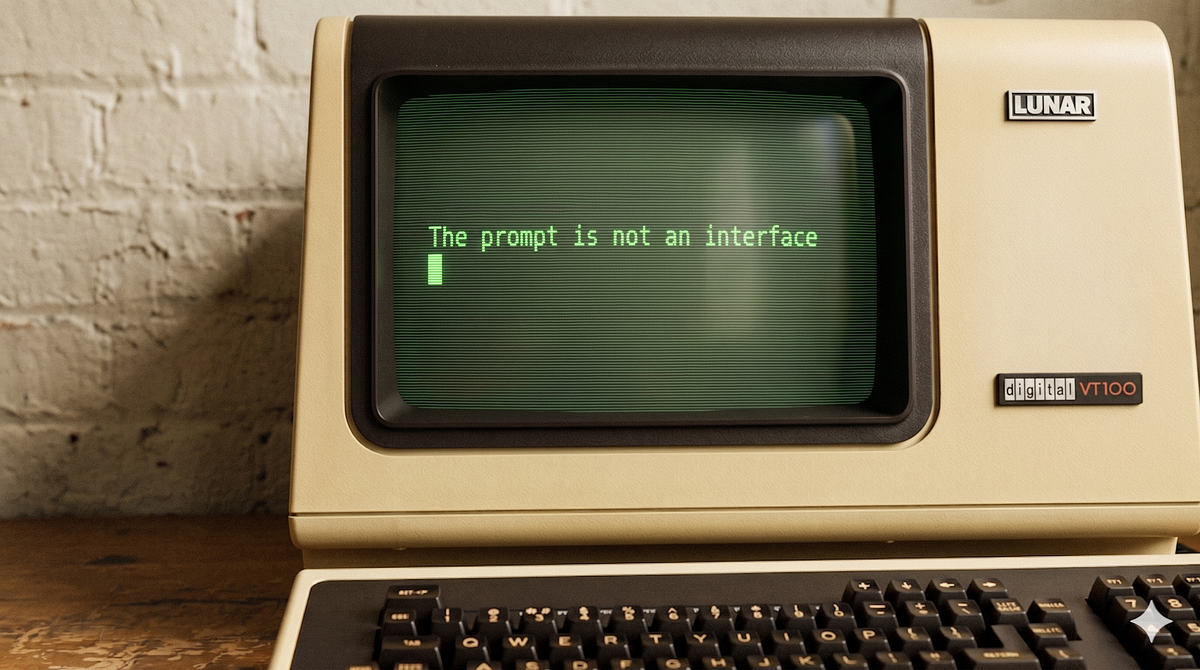
"For the last forty years, the entire trajectory of interaction design has been a movement away from the command line and toward direct manipulation. We moved from typing instructions to pointing, clicking, dragging, and seeing the results immediately. We built interfaces that showed us what was possible rather than demanding we memorise a syntax."
"For tasks that are inherently visual or spatial - layout, composition, colour, form, motion - the text prompt forces a translation that loses signal at every step. It asks creative professionals to abandon the visual systems they have used for centuries and communicate their intent through a medium structurally incapable of holding it."
"Then AI arrived, and we threw it all away. We retreated to the exact paradigm that a generation of researchers spent decades trying to escape: type what you want, and hope you chose the right words."
Modern AI systems represent a significant step backward in interaction design by forcing users to communicate through text prompts rather than visual interfaces. For forty years, designers moved away from command-line interfaces toward direct manipulation—pointing, clicking, dragging, and immediate visual feedback. Touchscreens further refined this by enabling direct finger-to-glass interaction. However, AI's arrival reversed this progress, returning users to typing instructions and hoping for correct word choices. This regression is particularly problematic for inherently visual and spatial tasks like layout, composition, color, and form, where text prompts force translations that lose critical information. Creative professionals must abandon centuries-old visual communication systems to express intent through a medium structurally unsuited for visual concepts.
#interaction-design-regression #ai-interface-limitations #visual-communication #user-experience-design #command-line-interfaces
Read at Medium
Unable to calculate read time
Collection
[
|
...
]