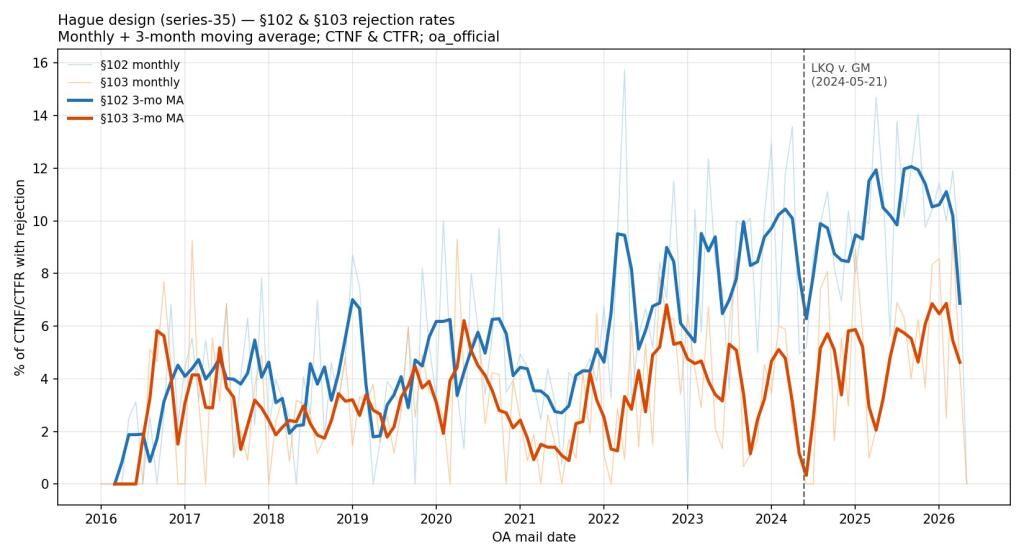
"We saw a huge change in our U.S. Design Patent system two years ago. In May 2024, the Federal Circuit decided LKQ v. GM, and ushering in a flexible obviousness test. The prior test was both rigid and restrictive and very few design patent applications were ever rejected as obvious. The new test opens the door to more rigorous obviousness examination."
"But, as the chart shows below, that is not happening. The fact remains that only about 1% of applications receive an obviousness rejection."
"For this analysis, I use Hague System cases because those file wrappers are public unlike ordinary design patent application files. The Hague agreement allows applicants to file a single international design application that can designate multiple countries, including the United States. This is PCT for design patents. In the U.S., Hague System applications are examined under the same substantive standards as domestic design patent applications."
A major change occurred in the U.S. design patent system in May 2024 when the Federal Circuit decided LKQ v. GM and introduced a more flexible obviousness test. The earlier obviousness standard was described as rigid and restrictive, resulting in very few design patent applications being rejected as obvious. The new approach is expected to allow more rigorous obviousness examination. Despite this change, only about 1% of applications receive an obviousness rejection. Hague System cases are used for analysis because their file wrappers are public. Under the Hague agreement, a single international design application can designate multiple countries, including the United States. In the U.S., Hague System applications are examined under the same substantive standards as domestic design patent applications.
Read at Patently-O
Unable to calculate read time
Collection
[
|
...
]