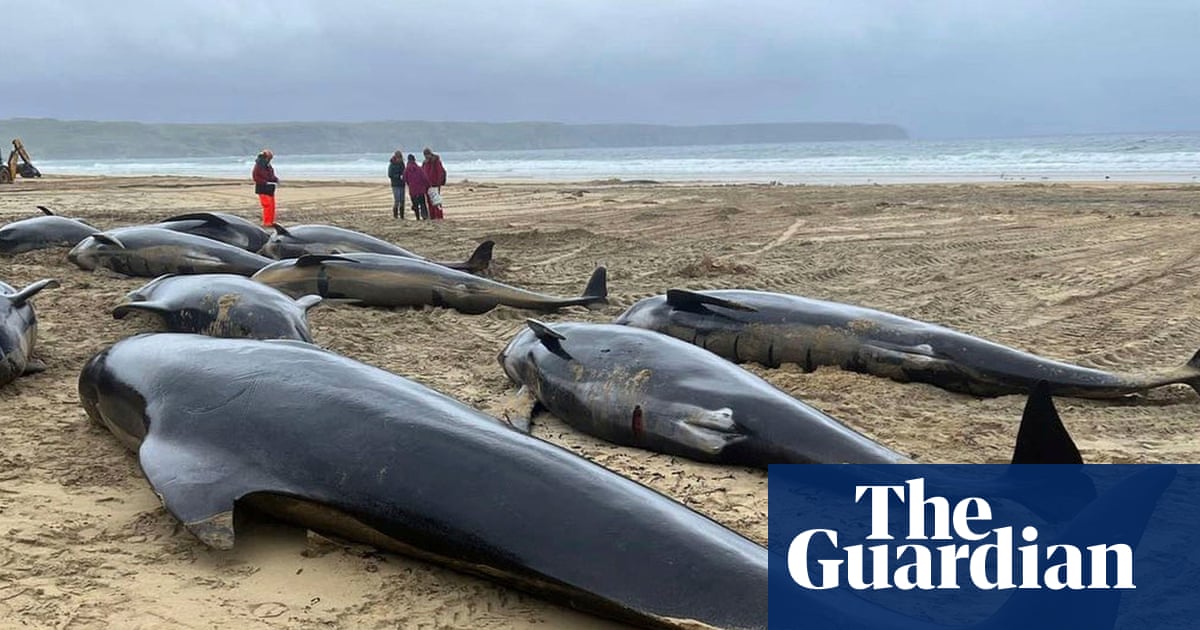
"The Tolsta event is a reminder that mass strandings are rarely the result of a single cause. Rather, they emerge at the intersection of individual physiology, group social behaviour and external marine environmental conditions. Understanding how these factors interact is essential if we are to improve our capacity to anticipate, interpret and, where possible, mitigate the impacts of a changing ocean."
"Postmortem examination suggested the female whale had been experiencing a prolonged and difficult birth, which acted as a trigger for the pod's fatal move into the shallow bay. Such behaviour in which a pod comes together to support a sick or injured member could be crucial to survival offshore as a means of defence from predators."
A Scottish government investigation concluded that 55 long-finned pilot whales stranded on Traigh Mhor beach in 2023 died due to their species' strong social bonds and protective behavior. The whales were in good health but followed a single female experiencing a prolonged and difficult birth into shallow water. The pod's tendency to aggregate closely around distressed members, normally a survival mechanism against predators, proved fatal in this instance. The stranding resulted from converging biological, behavioral, and environmental factors rather than a single cause like disease, trauma, or acoustic disturbance. Understanding interactions between individual physiology, group social behavior, and marine environmental conditions is essential for anticipating and mitigating future mass stranding impacts.
Read at www.theguardian.com
Unable to calculate read time
Collection
[
|
...
]