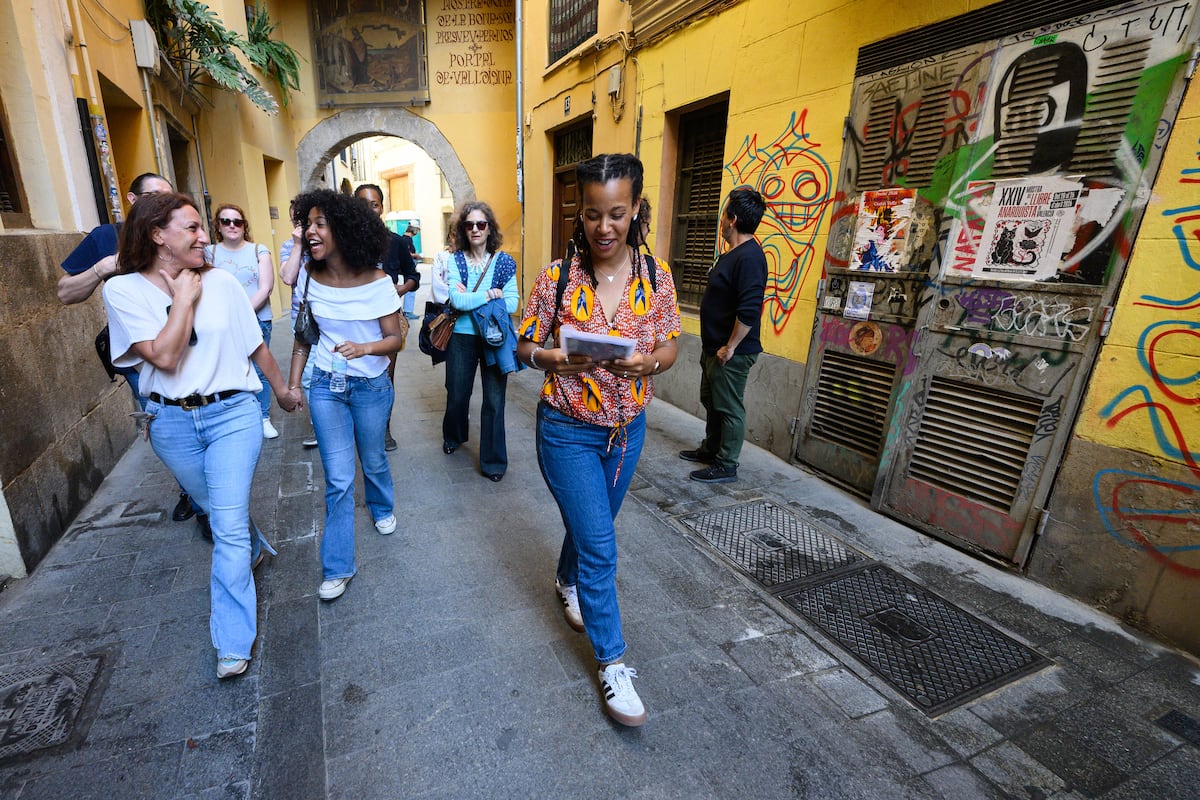
"The Central Market Square in Valencia, now filled with outdoor cafes and tourists photographing its modernist dome, was for centuries one of the main sites of the slave trade in the Spanish city. This is clearly documented by archival documents: from the late 15th century, this was one of the entry points for enslaved Africans. Just a few meters away, in the now-demolished Posada del Camell, more than a hundred people were sometimes crammed together in chains, waiting to be auctioned off. And yet, there is not a single plaque to commemorate it."
"We've walked past these places our whole lives without knowing what happened there, explains Deborah Ekoka, a Valencian cultural manager and the driving force behind Cartographies of Black Memory, a series of routes and activities that aims to recover the historical presence of Black and Muslim people in Valencia. The project has the support of the Trade Union Institute for Development Cooperation (ISCOD) and works in collaboration with the Valencian Museum of Ethnology (l'ETNO)."
"Ekoka was born in Valencia, but her father was from Equatorial Guinea. She says that growing up, she had to constantly answer the same question: Where are you from? Her father arrived in mainland Spain when Equatorial Guinea was still a Spanish overseas colony, with a Spanish national identity document. Even so, that origin with a Spanish mother and father has never been fully acknowledged because of the color of her skin. Valencia is no exception."
"In recent years, cities such as Madrid, Barcelona, Seville and Cadiz have begun revisiting their Black and slavetrading past through urban routes, cultural projects and academic work a history extensively documented in public and private archives, notarial records, censuses and even Inquisition accounts of autosdafe, yet absent from the national narrative. Miguel de Cervantes, for instance, described Seville as a chessboard, a reference to its mixed Black and white population, recalls Ana Grau, project"
The Central Market Square in Valencia, now associated with cafes and tourism, was a key location in the Spanish slave trade for centuries. Archival records place the site among late-15th-century entry points for enslaved Africans. Nearby, the demolished Posada del Camell sometimes held more than a hundred people in chains while they waited to be auctioned. Despite this documented history, there are no commemorative plaques. Deborah Ekoka leads Cartographies of Black Memory, which creates routes and activities to recover the historical presence of Black and Muslim people in Valencia. The project is supported by ISCOD and collaborates with l’ETNO. Ekoka describes how her family’s Spanish colonial-era identity was not fully recognized due to skin color. Other Spanish cities have begun revisiting their Black and slave-trading past through routes, cultural work, and academic research using archives and records, including Inquisition accounts.
Read at english.elpais.com
Unable to calculate read time
Collection
[
|
...
]