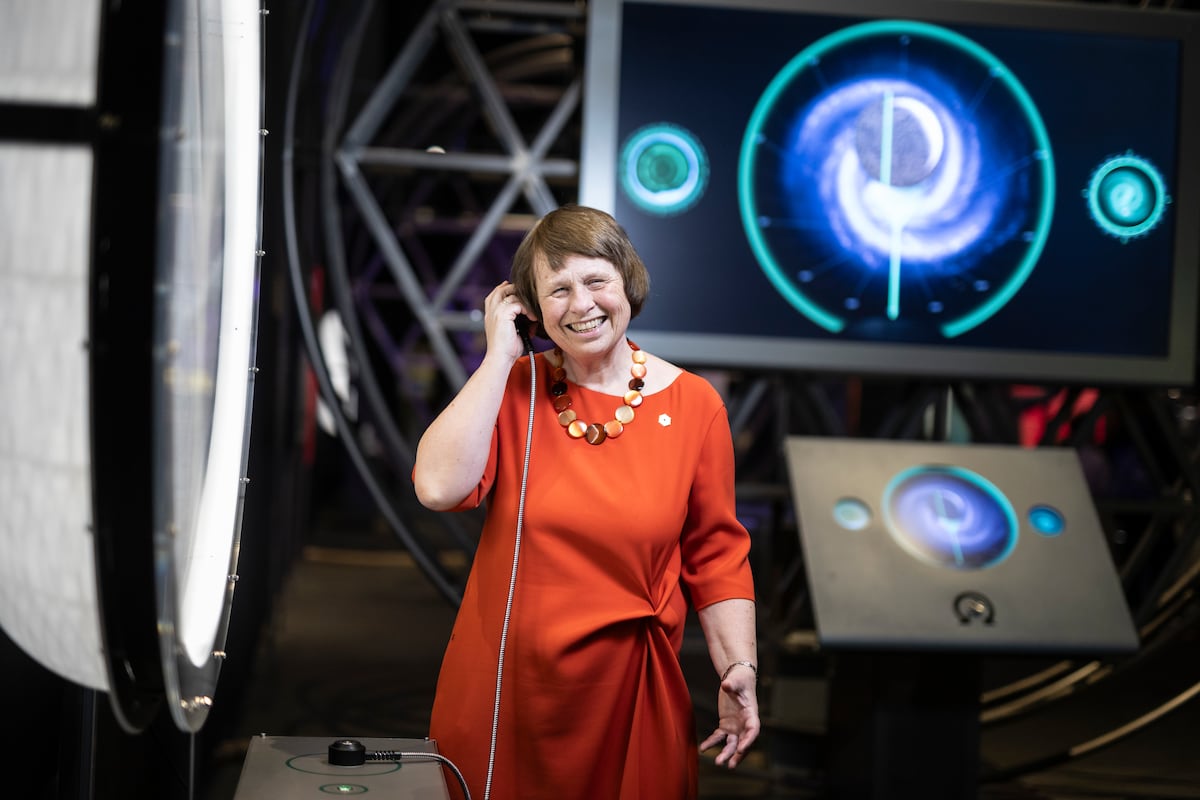
"Astrochemist Ewine van Dishoeck's laboratory is the universe, where chemical reactions take place that would be impossible on Earth. She calls herself a fan of interstellar dust and believes that as a woman, college was easier for her because the professors noticed you. Among her other honors, Van Dishoek won the Kavli Prize in astrophysics in 2018 for her combined contributions to observational, theoretical, and laboratory astrochemistry, elucidating the life cycle of interstellar clouds and the formation of stars and planets."
"When she left her hometown of Leiden in the Netherlands in 1968 to travel to San Diego, where her father an ENT specialist had been invited to a six-month stay, she couldn't have imagined that it was there that her interest in science would spark. My parents always had this ambition that I would go into medicine, because my whole family were doctors, says the 70-year-old Van Dishoeck. And so here I was in San Diego in a public high school, and there was this fantastic female African American teacher that was so inspiring in science."
"It didn't occur to me that this was special. In the Netherlands, I had lots of Latin and Greek and mathematics, but I'd had nothing of science yet. EL PAIS took advantage of her trip to Barcelona to take part in Cosmocaixa's Greats of Science series in order to speak with the scientist. Van Dishoeck's orange-colored outfit immediately reminded one of her country of origin. She wore a pin of 19 golden hexagons representing the James Webb Space Telescope, which she helped develop."
"What most fascinated you in your youth was chemistry. Answer. I was in quantum chemistry, hard stuff. And then the professor died, and as it goes with universities, they said, You have very good grades, but you better start looking elsewhere. Q. How did you wind up getting interested in astronomy? A. I started my PhD, and then it was my then-boyfriend and now-husband [Tim de Zeeuw, director of the European Southern Observatory"
Astrochemist Ewine van Dishoeck studies chemical reactions occurring in space, especially those involving interstellar dust that cannot be replicated on Earth. She received the 2018 Kavli Prize in astrophysics for combined observational, theoretical, and laboratory contributions that clarify the life cycle of interstellar clouds and the formation of stars and planets. Her interest in science began during a move from Leiden to San Diego in 1968, where an inspiring female African American science teacher influenced her. Although her family expected her to pursue medicine, she later pursued quantum chemistry and then shifted toward astronomy during her PhD. She also helped develop the James Webb Space Telescope, symbolized by a pin of golden hexagons.
#astrochemistry #interstellar-dust #star-and-planet-formation #james-webb-space-telescope #quantum-chemistry
Read at english.elpais.com
Unable to calculate read time
Collection
[
|
...
]