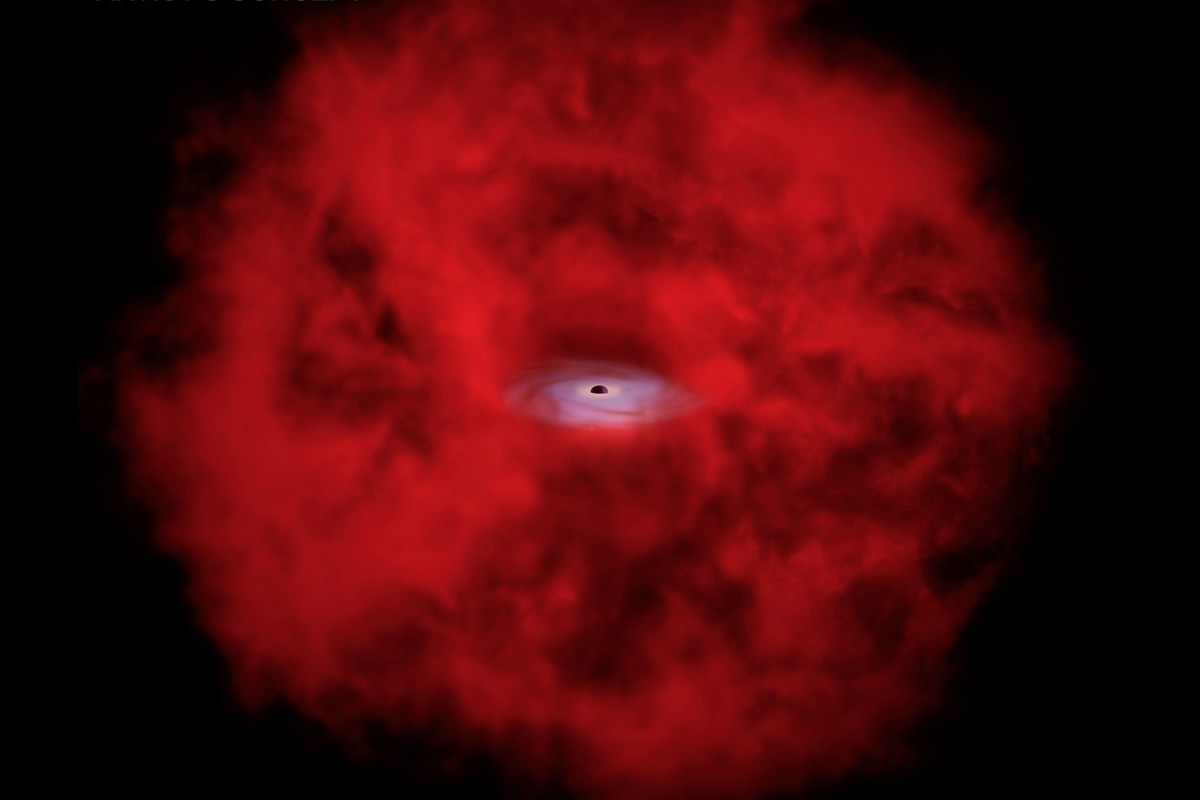
"Astronomers say they've found a new specimen, which they're calling an "X-ray dot," that suggests these crimson specks are a type of never-before-seen - and improbably extreme - stage of supermassive black hole evolution."
"By comparing old Chandra images with new ones taken by the James Webb Space Telescope, they found that one little red dot was emitting x-rays, a telltale emission of black holes."
"The little red dots are a class of luminous and unbelievably massive objects that existed in the universe's infancy, but are nowhere to be seen today. Until the James Webb Space Telescope came online in 2022 and began peering into the ancient universe with unprecedented clarity, no one even knew they existed."
"Many astronomers suspected that some kind of rapidly growing supermassive black hole must be at the heart of them, but until now, none of the hundreds of little red dots showed even the faintest trace of x-ray emissions. They were also strangely dim; a feasting supermassive black hole typically surrounds itself i"
Astronomers identified an “X-ray dot” by comparing older Chandra X-ray Observatory images with newer James Webb Space Telescope images. One little red dot was found to emit X-rays, a signature associated with black holes. Little red dots are extremely luminous, unbelievably massive objects from the early universe that are not observed today. They typically lie about 12 billion light years away, and some were detected when the universe was under a billion years old. Their mass rules out stars, and their compact size rules out normal galaxies. Many researchers suspected rapidly growing supermassive black holes, but hundreds of dots previously showed no detectable X-ray emission and appeared unusually dim.
#supermassive-black-holes #x-ray-astronomy #james-webb-space-telescope #chandra-x-ray-observatory #early-universe
Read at Futurism
Unable to calculate read time
Collection
[
|
...
]