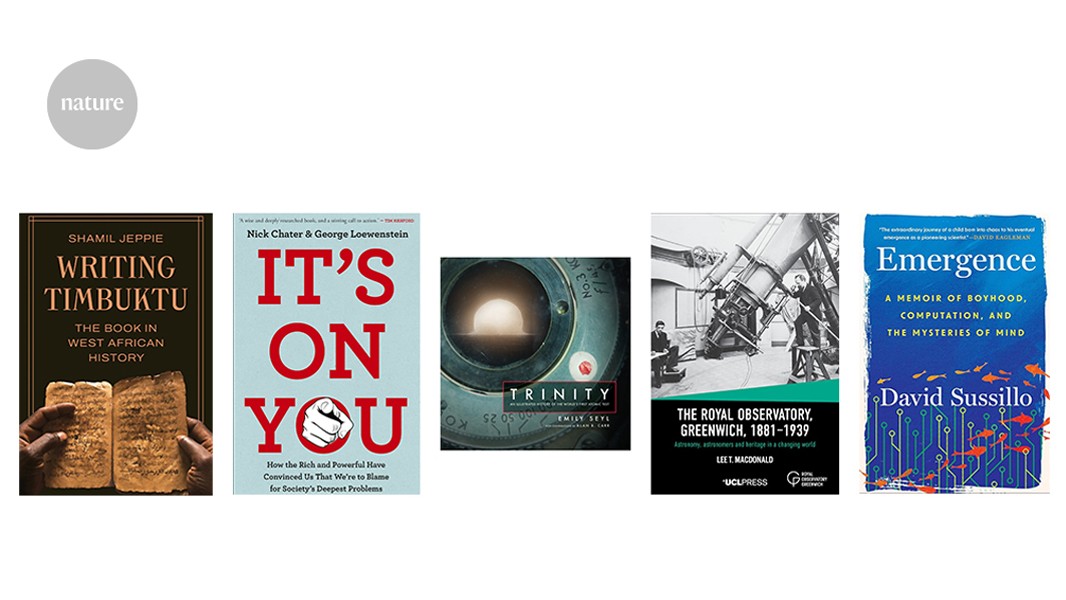
"Many books describe how the first atomic bomb was built. But this history by Emily Seyl stands apart. It tells the story of the bomb's Trinity test in New Mexico in July 1945 through restored photographs from the Los Alamos National Laboratory's National Security Research Center, where Seyl works. These include images of once-clandestine documents and experiments, as well as unfamiliar restored photographs of 'trinitite' - green glass found at the test crater - which fell from the bomb's fireball in molten drops."
"Can profound societal problems, such as climate change and obesity, be solved by nudging people to change their behaviour? Or do they require changes at the corporate and governmental levels? Psychologist Nick Chater and behavioural economist George Loewenstein once favoured the former view but now support the latter. "The primary challenge is to fix broken or malfunctioning systems," they argue. Hence, legislation is needed to control oil giants, rather than blaming individuals for their carbon footprints."
"When David Sussillo spoke about how he became a neuroscientist - after growing up with parents who were heroin addicts and prone to violence and neglect - he reduced his audience at the Princeton Neuroscience Retreat in New Jersey to near-silence. His brutally intimate memoir reveals that an early fascination with computing led him to study the brain, consciousness and artificial intelligence. He asks: "Does thinking control the neurons in your brain, or do the neurons in your brain cause thinking?""
Restored photographs from Los Alamos National Laboratory document the Trinity test in New Mexico in July 1945, including once-clandestine documents, experiments, and unfamiliar images of trinitite. Trinitite appears as green glass formed when molten drops from the bomb’s fireball cooled at the test crater. A behavioral perspective on major societal problems argues that nudging individuals is insufficient and that broken systems must be fixed. The approach emphasizes legislation and corporate and governmental responsibility, such as controlling oil giants, rather than blaming individuals for carbon footprints. A neuroscientist memoir connects early computing fascination to questions about consciousness and artificial intelligence, including whether thinking controls neurons or neurons cause thinking.
Read at Nature
Unable to calculate read time
Collection
[
|
...
]