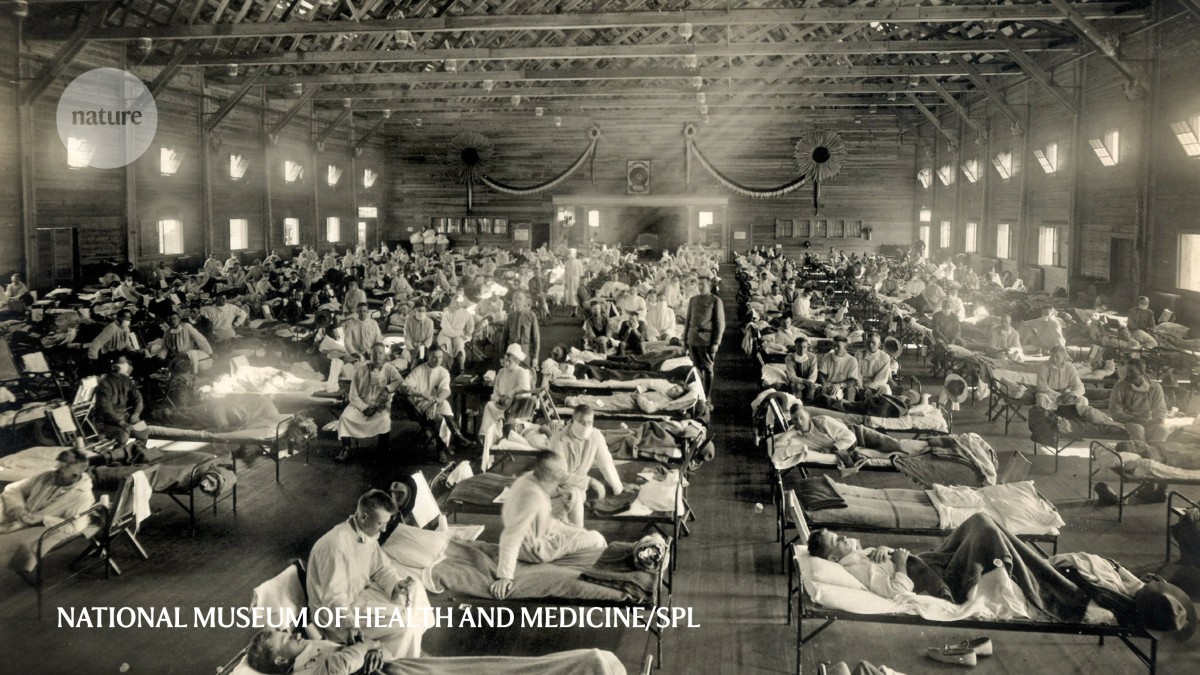
"Of all the pathogens that have plagued humanity, few are as notorious and persistent as influenza. Its Houdini-like ability to regularly slip the shackles of vaccine- or infection-induced immunity, aided by a steady and sustained mutation rate, has created a seasonal viral scourge that wreaks medical and economic havoc all over the world. Here, Nature outlines the history of flu and how it evades attempts to control it. Influenza is never far away. Its seasonality means it see-saws between Northern and Southern hemispheres on an annual basis, causing illness and death among not just humans but also poultry, cattle and birds and mammals in the wild."
"Every few decades or so, a chance mutation leads to an extraordinary pandemic event that can sweep the planet, claiming millions of lives. The 1918-19 flu pandemic caused 50 million deaths; for the 1957-58 pandemic it was 1 million to 4 million; in 1968-69, the death toll was also 1 million to 4 million; and in 2009-10 it was 105,000-395,000. Seasonal flu causes 290,000-650,000 deaths, globally each year. In 2015, flu caused losses of US$8 billion in wages and productivity in the United States alone."
"Influenza is a single-stranded RNA virus of the family Orthomyxovirus. Although the virus is most commonly referred to as flu, it has many names, subtypes and disguises. Alterations to two key proteins on the surface of the influenza A virus - the spike protein haemagglutinin that allows the virus to attach to host cells, and neuraminidase, which enables the virus to escape from host cells - mean that subtypes are identified according to variations in these proteins. Of the four types of influenza, only type A causes pandemics. Influenza A ( Alphainfluenzavirus) has 198 potential serotypes, consisting of combinations of the 18 known haemagglutinin (H) subtypes and the 11 known neuraminidase (N) subtypes."
Influenza causes recurrent seasonal epidemics and intermittent pandemics that have killed millions, with the 1918–19 pandemic causing about 50 million deaths and later pandemics causing up to four million each. Seasonal influenza causes an estimated 290,000–650,000 deaths worldwide annually and produced US$8 billion in lost wages and productivity in the United States in 2015. The virus cycles seasonally between Northern and Southern hemispheres and infects humans, poultry, cattle, birds and wild mammals. Influenza A is a single-stranded RNA Orthomyxovirus with high mutation rates; changes to haemagglutinin and neuraminidase drive subtype diversity and immune evasion.
Read at Nature
Unable to calculate read time
Collection
[
|
...
]