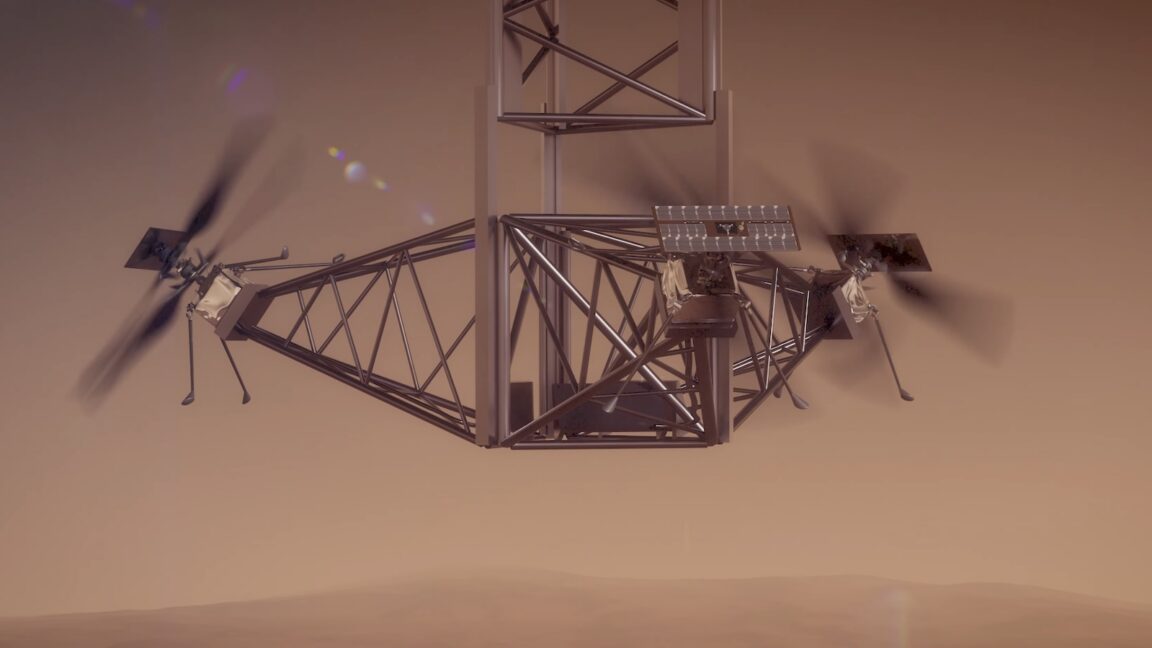
"The first series of tests used a three-bladed rotor design that could be flown on missions after SkyFall. A second test campaign used the actual two-bladed design that will fly on SkyFall. These blades are slightly longer, so they reached the same supersonic speed at a lower rpm. The faster spin resulted in a 30 percent boost in lift capability."
"The team pushed rotor tip speeds to Mach 1.08, boosting the Mars vehicle's lift capability by 30 percent. This breakthrough allows future missions to support heavier scientific payloads, including advanced sensors and larger batteries for extended flight."
""We thought we'd be lucky to hit Mach 1.05, and we reached Mach 1.08 on our last runs. We're still digging into the data, and there may be even more thrust on the table. These next-gen helicopters are going to be amazing," said Shannah Withrow-Maser, an aerodynamicist from NASA's Ames Research Center."
"The only payloads on the Ingenuity helicopter were two cameras: a black-and-white imager for navigation and a higher-resolution color camera. Its longest flight in 2022 covered less than a half-mile and lasted 161 seconds. The aircraft had to land and recharge its batteries using solar arrays, and it used the nearby Perseverance rover as a base station to communicate with ground teams on Earth."
A test program evaluated rotor designs for Mars helicopter missions after SkyFall. Early tests used a three-bladed rotor that could fly on later missions, while a second campaign used the actual two-bladed design planned for SkyFall. The two-bladed blades were slightly longer, reaching the same supersonic speed at lower rpm. Pushing rotor tip speeds to Mach 1.08 increased lift capability by 30%. This performance supports heavier scientific payloads, including advanced sensors and larger batteries for extended flight. Ingenuity carried only two cameras and flew short distances, landing to recharge via solar arrays and using the Perseverance rover for communication. SkyFall will rely on relay satellites or direct-to-Earth links, and future rotorcraft will use larger batteries for longer flights.
Read at Ars Technica
Unable to calculate read time
Collection
[
|
...
]