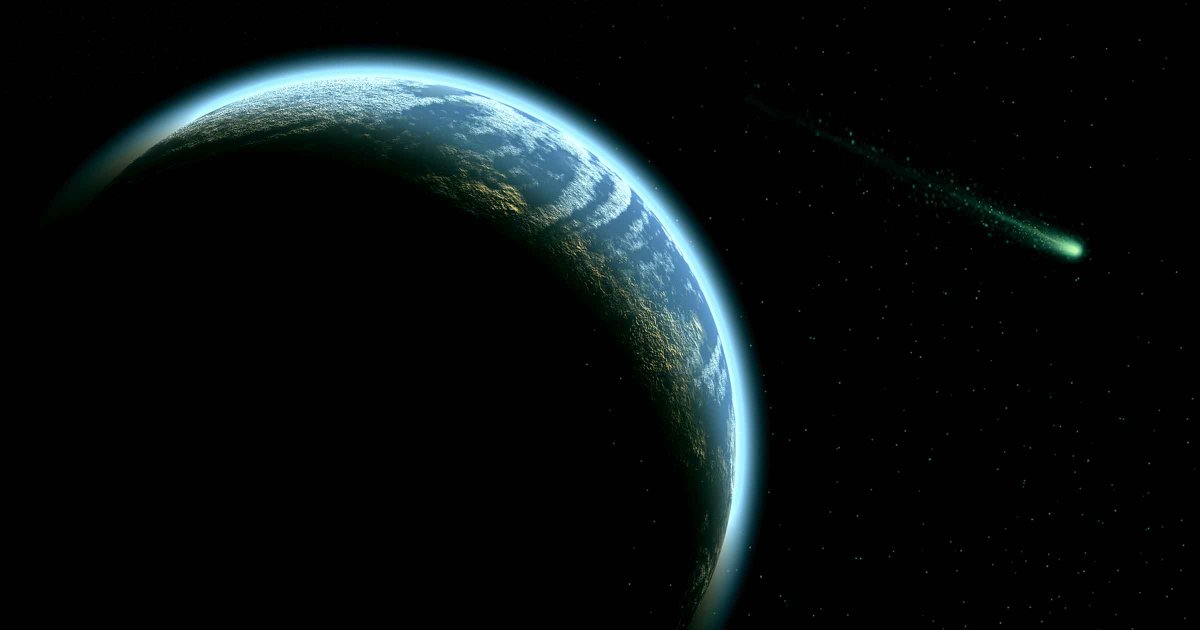
"For thousands of years, astronomers have watched Halley's Comet come and go, becoming visible to the naked eye every 72 to 80 years. That makes it a short-period comet, whose highly elliptical orbit takes it beyond Neptune before making its decades-long return. (The last time we caught a glimpse of the comet was in 1986, while its next appearance is slated for mid-2061.)"
"Other comets take far longer to orbit the Sun. As the New York Times reports, comet C/2025 R3 PANSTARRS, which was only discovered last year, has been visible to stargazers in the northern hemisphere for weeks now. However, once it's on its way out, it's not expected to return for another 170,000 years."
"It's origin is of particular interest to astronomers, who believe it came from the Oort Cloud, a giant spherical shell that blankets the solar system, representing the outermost edge of our star's gravitational influence. Researchers believe it's chock full of icy and rocky objects like C/2025 R3 PANSTARRS. Long-period comets are an exceedingly rare sight - and an exciting opportunity to get a precious glimpse of the furthest reaches of the solar system."
"Whether future civilizations will be able to see the visitor again isn't guaranteed. As the Perth Observatory's Matt Woods points out in a recent guide, gravitational interactions with the solar system's planets can eject comets form our star system altogether. Given its suspected origins, studying a "dirty snowball" comet like C/2025 R3 PANSTARRS could provide us with tantalizing clues about the earliest days of the solar system."
Halley’s Comet is a short-period comet with a highly elliptical orbit that extends beyond Neptune and returns every 72 to 80 years. It was last visible in 1986 and is expected again in mid-2061. Comet C/2025 R3 PANSTARRS was discovered in 2025 and has been visible in the northern hemisphere for weeks. After it leaves, it is not expected to return for about 170,000 years. Its origin is believed to be the Oort Cloud, a distant spherical region filled with icy and rocky objects. Long-period comets are rare and offer a brief observational opportunity. Gravitational interactions with planets can also eject comets from the solar system. Studying such “dirty snowball” comets may reveal clues about early solar system planetesimals.
Read at Futurism
Unable to calculate read time
Collection
[
|
...
]