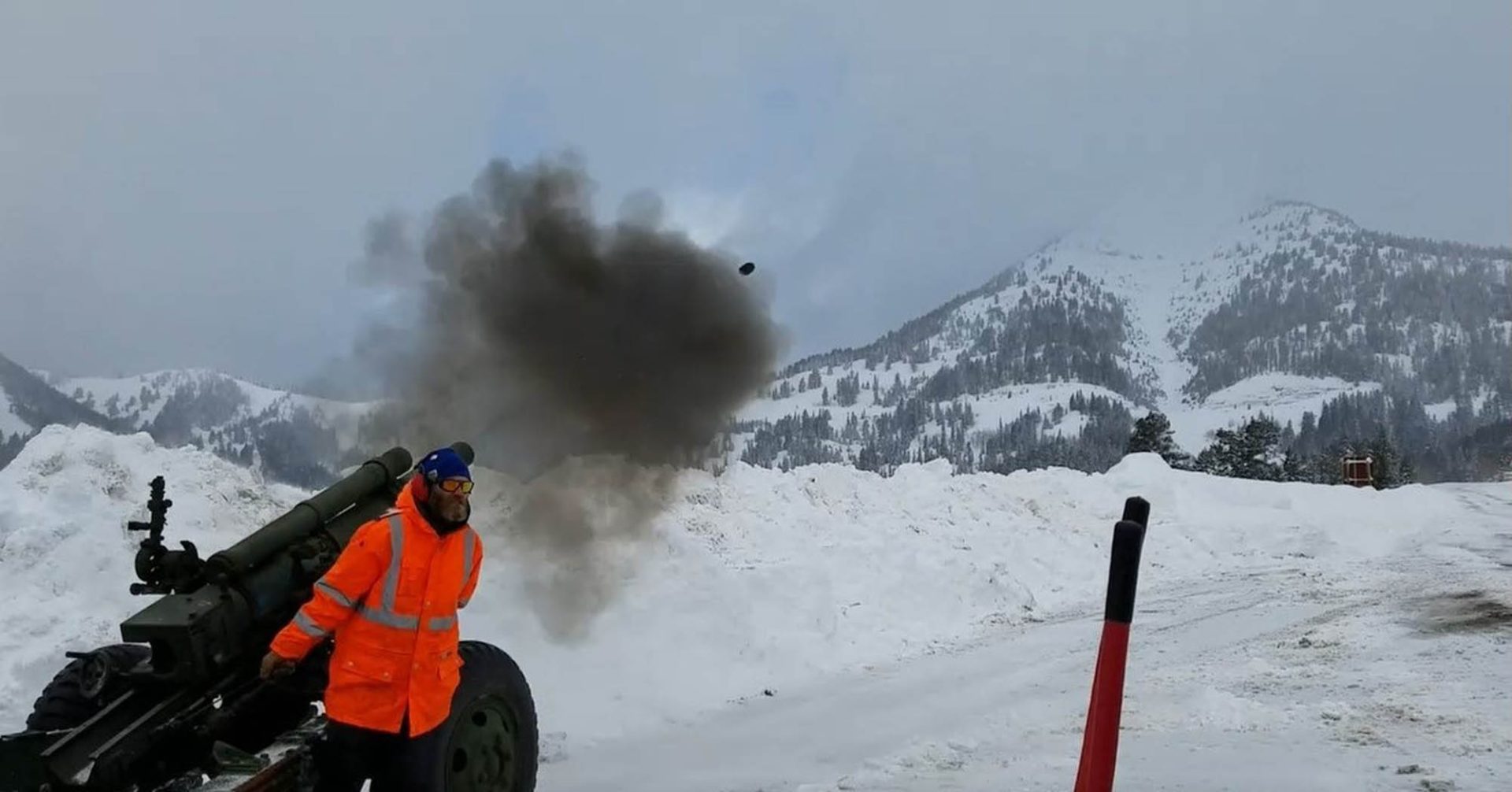
"Avalanche artillery mitigation has been at the center of a steadily evolving program to understand, predict, and control snowpack hazards. Many a skier has woken up to the thunderous, window-rattling booms of artillery fire from a nearby highway or ski area and known that sound is almost universally a sign of a good ski day. The combination of new avalanche mitigation strategies, dwindling supplies of the surplus ammunition used for mitigation, and retirements of people who know how to service an aging arsenal of howitzers has culminated in a more than decade-long push to eliminate reliance on artillery for avalanche mitigation."
"Despite the continual development of new technologies for avalanche mitigation and a deepening understanding of where and why avalanches form, military artillery offers distinct advantages over other methods. Howitzers and recoilless rifles, the centerpiece of many avalanche mitigation programs for 75 years, are certainly on their way out, but the holes they leave behind are not so easily filled."
"Avalanches are caused by mechanical failures, or fractures, within a snowpack. These fractures occur at weak points between the layers of the snowpack, sometimes in a layer of an especially weak type of snow crystal, and sometimes where new snow has not yet bonded with the old snow it is falling on. A skier, in the wrong place at the wrong time, can initiate a fracture and eventually an avalanche, but that is not the only way of initiating an avalanche."
"The blast from an explosion can provide more than enough mechanical energy to initiate a fracture, and if that fracture occurs in a starting zone, or in a part of the mountain with a slope angle steeper than roughly 30 degrees, an artificially triggered ava"
Avalanche artillery mitigation has evolved alongside chairlift use in Western North America, aiming to understand, predict, and control snowpack hazards. Artillery fire has long been used to trigger avalanches, with booming sounds signaling mitigation activity. New strategies, reduced availability of surplus ammunition, and retirements of personnel who maintain aging howitzers have driven a push to eliminate reliance on artillery over the past decade. Artillery offers advantages because explosions can supply mechanical energy that initiates fractures within a snowpack. Fractures form at weak points between snow layers, including weak crystal layers or areas where new snow has not bonded to older snow. If a blast-induced fracture occurs in a starting zone on slopes steeper than about 30 degrees, an avalanche can result.
#avalanche-mitigation #snowpack-physics #artillery-and-explosives #mountain-safety #ski-resort-operations
Read at SnowBrains
Unable to calculate read time
Collection
[
|
...
]