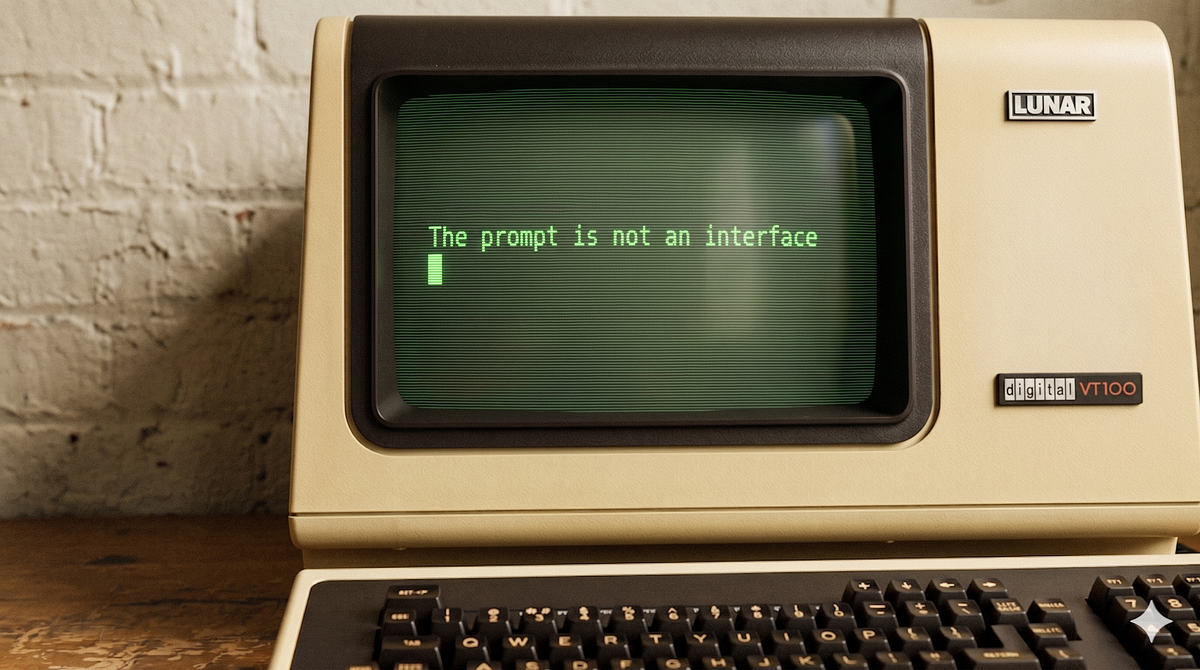
"The most advanced artificial intelligence systems in history now ask us to communicate through a blinking cursor in an empty text box. We have, in the most literal sense, gone backwards. For the last forty years, the entire trajectory of interaction design has been a movement away from the command line and toward direct manipulation. We moved from typing instructions to pointing, clicking, dragging, and seeing the results immediately. We built interfaces that showed us what was possible rather than demanding we memorise a syntax."
"Then AI arrived, and we threw it all away. We retreated to the exact paradigm that a generation of researchers spent decades trying to escape: type what you want, and hope you chose the right words. This is a structural failure. For tasks that are inherently visual or spatial - layout, composition, colour, form, motion - the text prompt forces a translation that loses signal at every step. It asks creative professionals to abandon the visual systems they have used for centuries and communicate their intent through a medium structurally incapable of holding it."
"Then, with the touchscreen, we removed even the mouse, the most direct manipulation yet, a finger on glass, the interface collapsing to almost nothing between intention and action. Then AI arrived, and we threw it all away. We retreated to the exact paradigm that a generation of researchers spent decades trying to escape: type what you want, and hope you chose the right words. This is a structural failure for tasks that are inherently visual or spatial."
"First, the command line. The earliest computers were not personal. They were institutional machines operated by specialists, communicating through punched cards and paper tape. You submitted a job, waited hours, and collected your output. The machine and the human occupied entirely separate time zones. The interactive terminal changed this. For the first time, a human and a computer could exchange information in the same session."
Advanced AI systems often require communication through a blinking cursor in an empty text box. This reverses interaction design trends from command-line typing toward direct manipulation, where users point, click, drag, and immediately see results. Touchscreens further reduced the gap between intention and action by collapsing the interface to minimal gestures. AI instead returns to a paradigm that depends on typing the right words. This creates a structural failure for visual and spatial tasks such as layout, composition, color, form, and motion, because prompts require translating visual intent into text, losing information at each step. Creative professionals are pushed away from visual systems they have used for centuries.
#ai-interaction-design #text-prompts #direct-manipulation #visualspatial-tasks #human-computer-interaction
Read at Medium
Unable to calculate read time
Collection
[
|
...
]