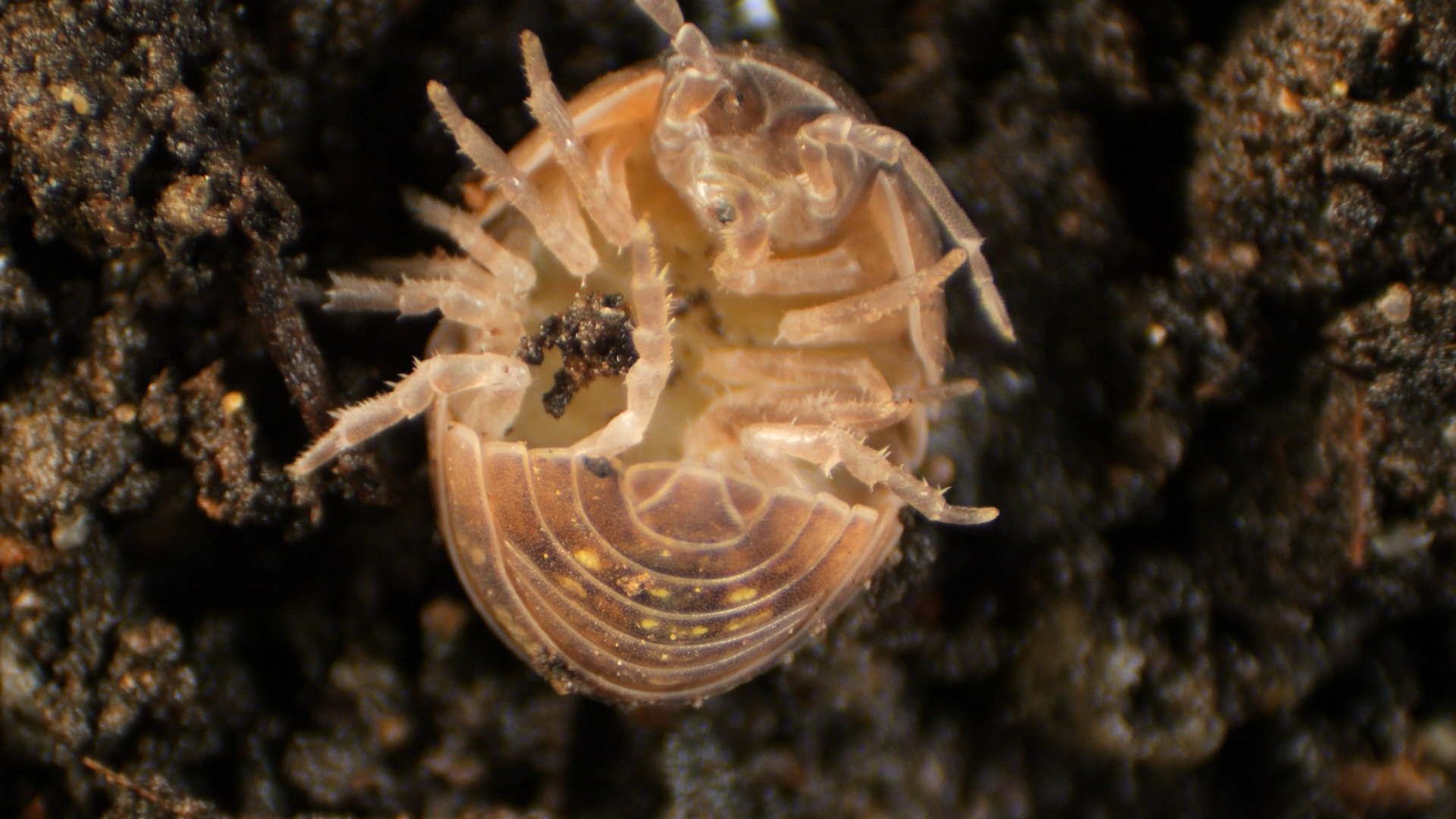
"Unlike mammals, most insects take a hands-off approach. They find a good spot, lay their eggs and move on. Good luck, little one! But roly-polies, also called pill bugs, or doodle bugs, aren't like most insects. Actually, they aren't insects at all. They're crustaceans, like shrimp and lobsters. Roly-polies belong to a group of crustaceans called isopods, which originated in the sea."
"After mating, a female roly-poly transfers her eggs into a fluid-filled pouch on her underside called a marsupium. At first the marsupium just looks yellow. But it doesn't take long - just a few days - 'til you can spot the eggs - about 40-60 of them! Keeping them close is a good strategy. If she were to lay her eggs on land, they'd dry out. They don't have the protective outer barrier of an insect egg to keep moisture in."
"Roly-polies are clad in overlapping armored plates called pereonites. If she gets spooked she can curl up in a perfect little ball to shield herself and her babies. The marsupium is protected by more plates called oostegites. But they're thinner ... almost clear, like a window into her nursery. After 3 to 4 weeks, the babies, now called mancae, emerge from the eggs."
"They look like miniature yellow versions of their mom. But they aren't ready to face the world yet. They keep developing inside their mama's pouch for another week or so. As they mature, they start getting restless. Sixty squirming babies in one crowded pouch. A feeling only a mother could love. The mancae eventually wriggle out from between the plates covering their mom's pouch."
Most insects lay eggs and leave them, but roly-polies are crustaceans rather than insects. Roly-polies are isopods that originated in the sea, and their ancestors carried a maternal adaptation onto land. After mating, a female transfers eggs into a fluid-filled pouch on her underside called a marsupium. The pouch protects eggs from drying out by keeping them in a moist environment without an insect-style protective outer barrier. The marsupium is guarded by overlapping armored plates, and the female can curl into a ball when threatened. After several weeks, eggs hatch into mancae that remain in the pouch for additional development before emerging.
Read at Kqed
Unable to calculate read time
Collection
[
|
...
]