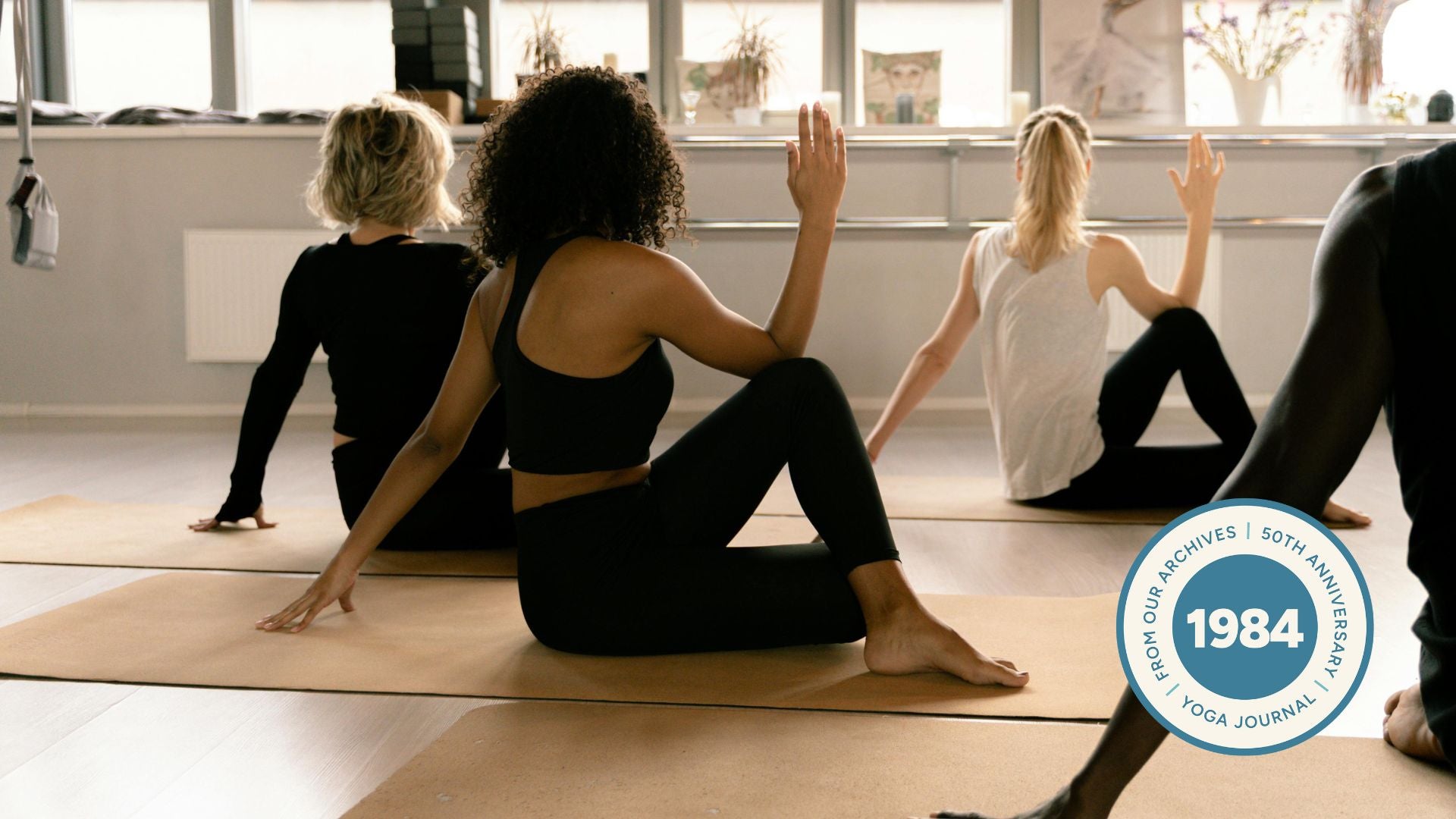
"Yogis discovered the joys of twisting long before the dance craze captured America's attention in the early '60s. Improved abdominal circulation and toning of the abdominal muscles, relief of pain in the hips and shoulders, increased blood flow to the spinal nerves, and greater elasticity and strength of the spine are some of the many physiological benefits derived from practicing the twisting asanas."
"Of major importance also are the effects on the spinal discs, the shock absorbers that separate the vertebral bodies. The rotation of the spine moving into a twist compresses the soft-tissue discs; the de-rotation coming out of the twist releases them. This squeezing and releasing produces a sponge-like action that allows the disc cells to absorb fresh nutrients and eliminate metabolic wastes. Without this action, the discs will slowly dehydrate and eventually degenerate, causing the shrinking height so often seen in older adults."
"However, the compression of the discs in twisting exacerbate any disc pathology. Thus, twists are contraindicated for anyone with neurological indications of disc troubles (numbness or sharp tingling pain in the lumbar, pelvic, or leg regions). The safe practice of twists requires precise kinesiology, i.e., clean movement of the bones. Each joint should open and extend from its center, with each bone (and its corresponding connective tissue) having independent intelligence."
Twisting asanas improve abdominal circulation and tone abdominal muscles, relieve hip and shoulder pain, increase blood flow to spinal nerves, and increase spinal elasticity and strength. Rotation into a twist compresses spinal discs, and de-rotation releases them, creating a sponge-like squeezing and releasing that allows disc cells to absorb nutrients and eliminate wastes. Without such action, discs dehydrate and degenerate, contributing to shrinking height in older adults. Twists can exacerbate existing disc pathology and are contraindicated for neurological signs such as numbness or sharp tingling in the lumbar, pelvic, or leg regions. Safe twisting requires precise kinesiology with joints opening from their centers and bones and connective tissues moving independently.
Read at Yoga Journal
Unable to calculate read time
Collection
[
|
...
]