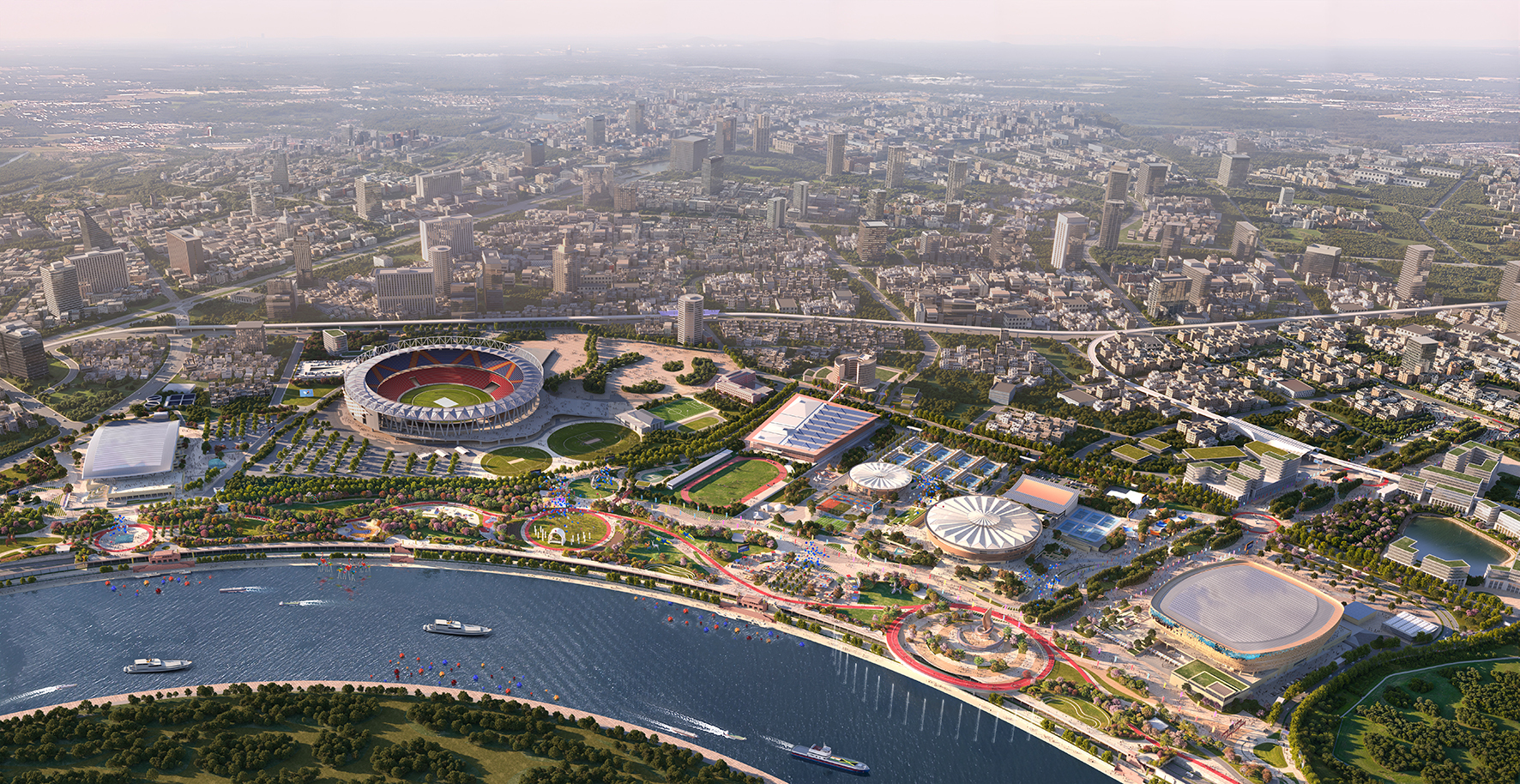
"Positioned on the Sabarmati Riverfront and structured around the 132,000-seat Narendra Modi Stadium, the world's largest stadium by capacity, the project proposes a large-scale sports district integrating international competition venues with public landscapes and community facilities. Conceived as both an events precinct and an urban park, the development is intended to accommodate the 2030 Commonwealth Games centenary event."
"The master plan is organized around a central green boulevard that structures movement across the site and links a series of major venues: an International Tennis Centre, an Indoor Arena, an Aquatic Centre, and a National Institute of Sports Excellence. A mandala-based grid informs the spatial layout, coordinating pedestrian routes, landscaped podiums, and shaded public spaces."
"The design emphasizes climate-responsive strategies, including tree-lined corridors, recessed plazas, and passive cooling measures integrated into the buildings' envelopes. Landscape is treated as connective infrastructure, mediating between large-capacity venues and the surrounding riverfront while maintaining visual and physical continuity with the stadium."
The Sardar Vallabhbhai Patel Sports Enclave master plan creates a large-scale sports district on the Sabarmati Riverfront centered around the 132,000-seat Narendra Modi Stadium. The development serves as both an events precinct and urban park, designed to host the 2030 Commonwealth Games centenary. A mandala-based grid organizes the site around a central green boulevard connecting major venues including an International Tennis Centre, Indoor Arena, Aquatic Centre, and National Institute of Sports Excellence. Climate-responsive design strategies incorporate tree-lined corridors, recessed plazas, and passive cooling measures. The International Tennis Centre features a 10,000-seat main stadium, secondary courts, and eight match courts with lightweight tensile roofing for natural ventilation and year-round operation.
#sports-infrastructure #urban-master-planning #climate-responsive-design #commonwealth-games-2030 #riverfront-development
Read at ArchDaily
Unable to calculate read time
Collection
[
|
...
]