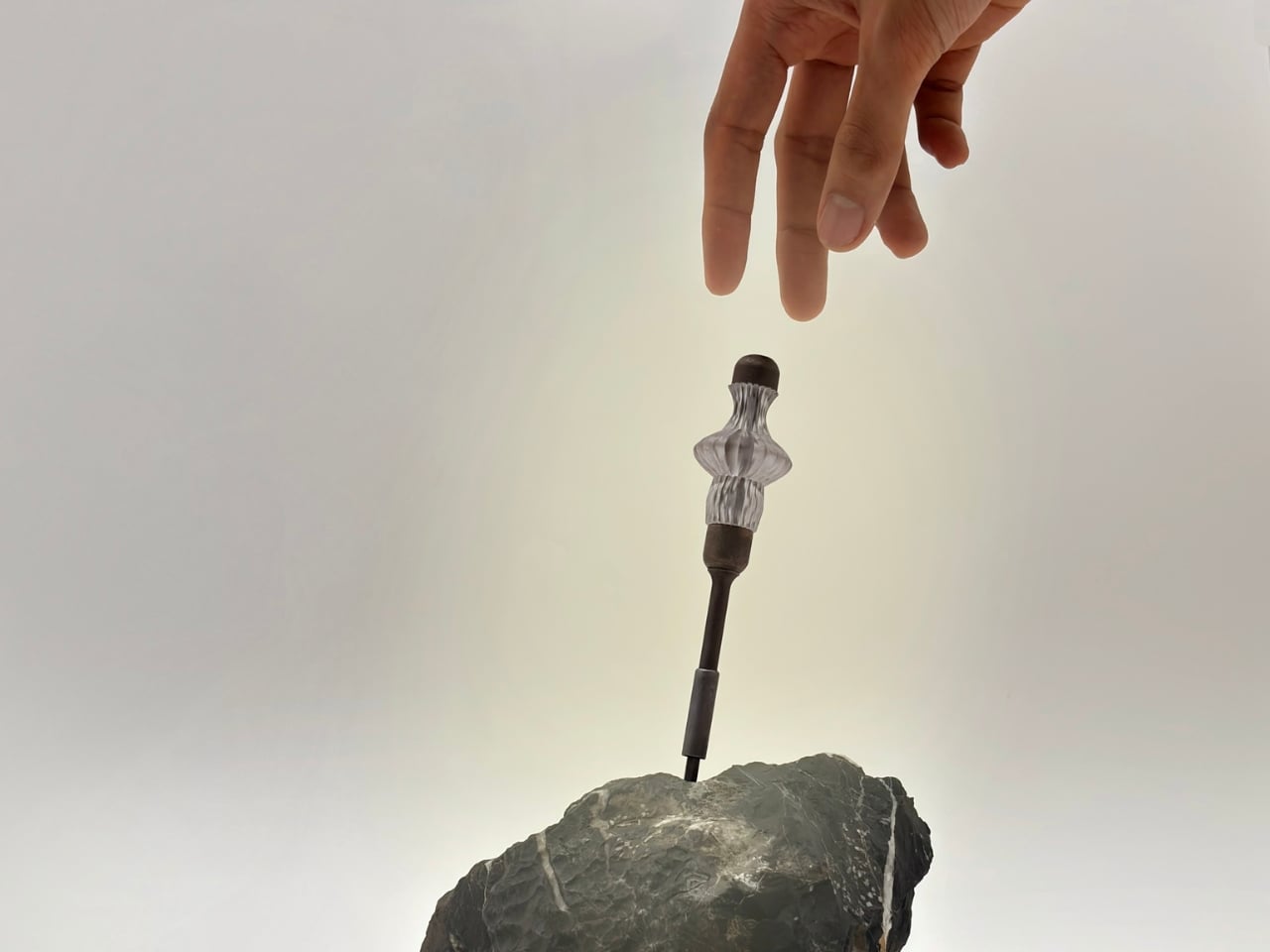
"Someone in a design studio somewhere decided how your hand should hold a screwdriver, how long the shaft should be, how thick the grip ought to feel. They tested it on a handful of people, ran the ergonomic studies, picked a shape, and shipped it to millions. The assumption is always the same: one form, optimized for an average that doesn't actually exist, should work for everyone."
"The system is deceptively simple in concept. A permanent titanium spine handles all the structural work, the torque, the load, the mechanical reality of driving a screw. Everything else around it, the grip, the length, the feel, is modular and replaceable. Segments can be added or removed to change the tool's reach. Grip files are open-source, meaning anyone with access to a 3D printer or a block of wood and some patience can shape their own handle."
"Most product design operates on a model of authority: the designer knows best, the user receives the finished object, and any modification is either warranty-voiding or just plain weird. Garg's project flips that relationship. The designer provides a skeleton and a set of rules. The user provides the identity."
Traditional tool design imposes standardized forms based on average ergonomic studies applied to millions of users, despite individual variation. Siddhant Rai Garg's final-year project challenges this approach by separating structural and non-structural components. A permanent titanium spine provides mechanical integrity while modular grip segments and open-source handle files enable users to customize length, feel, and appearance. Users can add, remove, or 3D-print personalized grips, shifting design authority from manufacturer to user. This philosophical approach redefines the designer's role from imposing finished solutions to providing structural frameworks and customization rules, enabling users to define their tool's identity.
Read at Yanko Design - Modern Industrial Design News
Unable to calculate read time
Collection
[
|
...
]