Fashion & style
fromwww.cntraveler.com
21 hours agoI Tested Carl Friedrik's First Aluminum SuitcaseHere's What I Thought
An aluminum suitcase combines style and performance, making it a timeless investment for travelers.
Most water filter pitchers are made of BPA-free plastic. But as new research shows that bottled-water drinkers ingest tens of thousands of excess microplastic particles, wellness lovers have begun to look askance at water filters that are themselves made of plastic.
Photovoltaic (PV) solar energy represents a modular technology that can be manufactured in large-scale facilities, generating economies of scale, while also being adaptable to small-scale applications. From residential rooftop systems to large-scale power generation installations, photovoltaic solar energy has established itself as a cost-effective option for electricity production in many countries around the world.
In the nineteenth century, entire railway networks became obsolete almost overnight, not due to physical deterioration, but because of changes in the technical standards that supported them. The expansion of railroads across Europe and North America adopted different track gauges, and as a dominant standard gradually emerged, these infrastructures became incompatible with one another.
Perforated metal has long been valued for its strength, versatility, and clean visual appeal. Created by punching patterns of holes into metal sheets, it offers a practical balance between airflow, light control, and structural support. Across industries such as architecture, construction, mining, and interior design, perforated metal has become a go-to material for projects that require both function and style.
Stress-skin panel construction is probably the most energy-efficient and cost-effective building method available today. With super-high insulation levels and airtightness, a stress-skin panel house should have extremely low heating and cooling costs. A reduction of 50% on utility bills as compared to a typically constructed house is reasonable.
This corn-based construction material was made by Manufactura, a Mexican sustainable materials company, and it imagines a second life for waste from the most widely produced grain in the world. The project started as an invitation by chef Jorge Armando, the founder of catering brand Taco Kween Berlin, to find ways he could reintegrate waste generated by his taqueria into architecture. A team led by designer Dinorah Schulte created corncretl during a residency last year in Massa Lombarda, Italy.
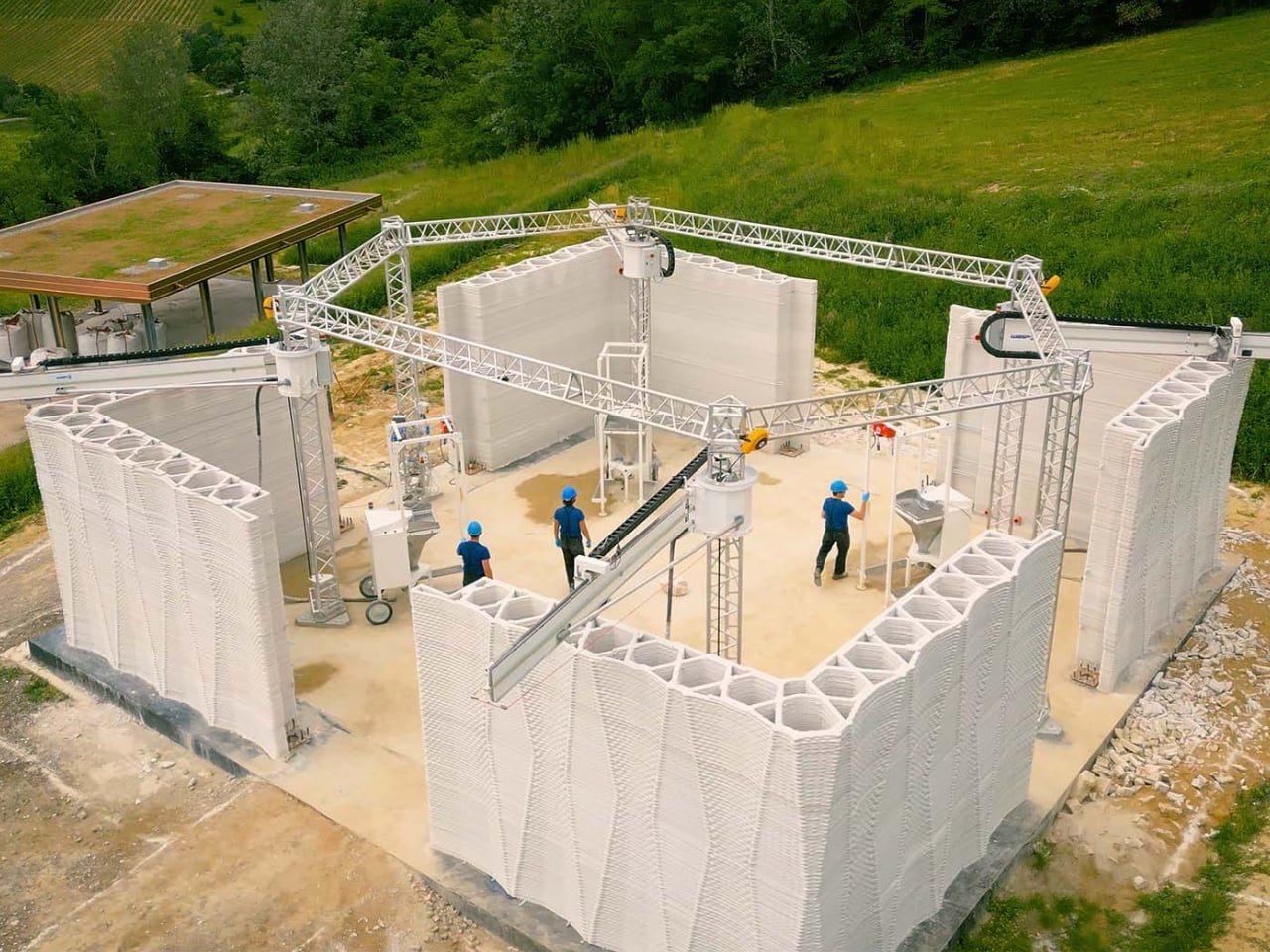
According to the outlet SlashGear, the neighborhood encompasses five 1,000-square-foot houses just north of Sacramento. Each domicile is produced by a hulking concrete printer worth about $1.5 million, which took about 24 days to spit out the first house. In the future, 4Dify expects the whole process to take about 10 days, but that isn't what's astonishing about the Yuba County neighborhood - it's the price tag.
What began as a modest brief for a young and growing family soon evolved into a considered renovation that reimagines an existing Barwon Heads home. The original house had endured several unsympathetic alterations over the years, leaving it disjointed and built to a poor standard.
Topped with a roof shaped like a crabshell, Le Corbusier's Chapelle Notre-Dame-du-Haut is a sanctuary amid the French mountainside. The 1955 construction rests atop a hill in Ronchamp, standing unobstructed by the otherwise forested inclines. As the sun rises and falls, light filters in through the mélange of rectangular windows tinted to cast streams of color around the space. The stained glass apertures of Le Corbusier's modernist chapel are a clear reference point for Luftwerk's "Open Frame."
Researchers at the Norwegian University of Science and Technology and the University of Tokyo have made a prototype of botanical cement made of desert sand and plant-based additives in hopes that it can be used to build houses and roads. Once mixed, the team adds tiny pieces of wood together and presses them all with heat to produce the cement.
One of the earliest large-scale examples of composite materials can be found in the Great Wall of China, where stone, clay bricks, and organic fibers such as reeds and willow branches were blended to create a resilient and lasting structure. These early techniques reveal a timeless intuition: distinct materials, when combined thoughtfully, produce properties unattainable by any single element.
When you think about building a house, what materials come to mind? Brick, wood and metal all come to mind; there are also some very distinctive glass houses out there. (Even if their occupants should refrain from throwing stones - though honestly, that's a good tip for indoor living in general.) A group of MIT researchers have come up with a very different way of making buildings, and it's one that also addresses an ongoing waste issue."We've estimated that the world needs about 1 billion new homes by 2050. If we try to make that many homes using wood, we would need to clear-cut the equivalent of the Amazon rainforest three times over," explained AJ Perez, who conducts his research in the MIT Office of Innovation. The title of a paper written by Perez and his colleagues - "Design, Manufacture and Testing of Structural Trusses Using Additively Manufactured Polymer Composites" - gives a sense of the solution that they have in mind.
Mexico's construction sector faces significant environmental and social challenges. The widespread use of carbon-intensive materials has positioned the industry as a major contributor to national CO₂ emissions. At the same time, construction labor conditions remain unstable, with limited access to technical training and high occupational risk. CORNCRETL, developed by MANUFACTURA, proposes a circular material strategy that addresses both environmental impact and production models within the building industry.
Having explored adaptability at the city scale, we are now zooming in on the building itself-and, crucially, on practice. How can architects, developers, and consultants embed adaptability as a measurable, mainstream outcome? This question will be on the agenda at the Adaptable Building Conference (ABC) on January 22 at the Nieuwe Instituut in Rotterdam, where architects, engineers, policymakers, and industry leaders will explore the potential of adaptable buildings-and how to deliver them at scale.
For many years, bamboo has been mostly known as the favourite food of giant pandas, but a group of engineers say it's time we took it seriously as a building material, too. This week the Institution of Structural Engineers called for architects to be bamboo-ready as they published a manual for designing permanent buildings made of the material, in an effort to encourage low-carbon construction and position bamboo as a proper alternative to steel and concrete.
Thermal modification is not a new invention, but its relevance has increased as expectations around performance, sustainability, and predictability have tightened. Developers, architects, and contractors are no longer just asking whether timber looks good or performs well initially. They want to know how it behaves after ten, twenty, or thirty years, and how much risk it introduces into a project once the scaffolding is gone.
How did a material conceived for bridges, factories, and large-scale structures make its way to the living room bench, the apartment bookshelf, the café table? For centuries, metal was associated with labor, machinery, and monumentality-from the exposed structures of 19th-century World's Fairs to the productive logic of modern industry. Its presence in domestic interiors is not self-evident but rather a cultural achievement: the transformation of an industrial material into an element of everyday, intimate use, in close proximity to the body.
From the large industrial roofs and galleries of the 19th century to the contemporary atriums of museums and public buildings, glass has been a recurring material in shaping large and monumental interior spaces. More than a technological or engineering solution, these horizontal glazed planes introduce a distinct luminous quality: light that comes from above. Unlike lateral daylight entering through façades, zenithal light is more evenly distributed, reduces harsh shadows, and lends spaces a sense of continuity and openness that is difficult to achieve otherwise.
In a balance of aesthetics, performance, and versatility, HIMACS shows a solid surface material of choice for many architects and designers. Taking a further step forward, the entire range of standard HIMACS sinks and basins is now officially SCS certified, containing a minimum of 8% pre-consumer recycled content. This certification enhances the material's technical and visual appeal by providing a more sustainable option without compromising quality or functionality.
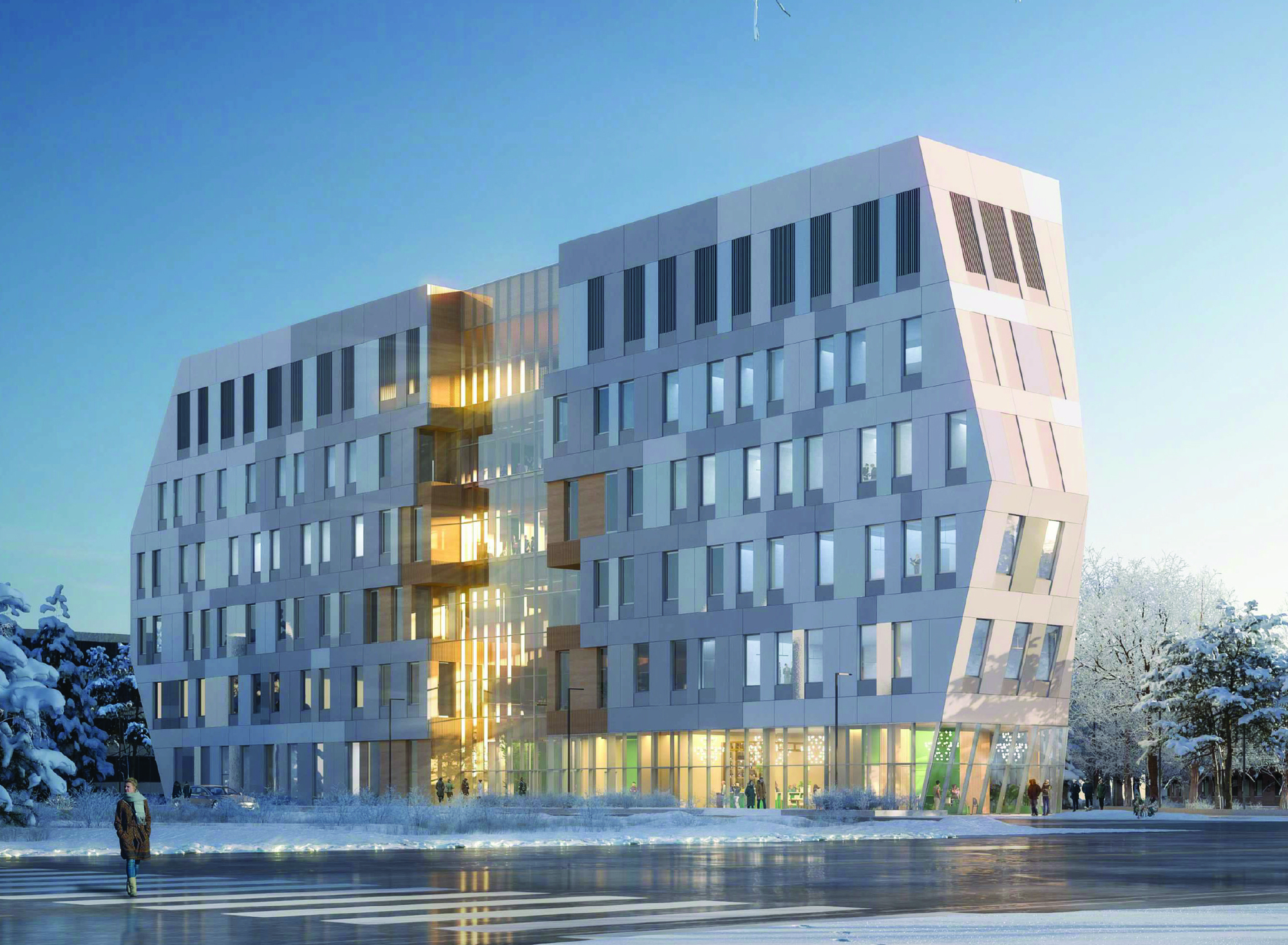
The site lies within the Petite Arche joint development zone, where design considerations include the town entrance, contextual integration, and alignment with natural elements. The building's form signals its position in an urbanized area and maintains visual dialogue with the surrounding landscape, including the protected Saint-Germain-En-Laye forest. A vegetated threshold along the northern edge reinforces landscape continuity, while the southern boundary engages with the urban character of the area.
Drawing Architecture Studio presents The Clock House No.2 at the 7th Shenzhen Bay Public Art Season in Shenzhen, Guangdong Province, China, on view until April 19th, 2026. Commissioned for the public art program, the Beijing-based practice reinterprets the historical automaton clock as architecture, using low-cost industrial components to construct a structure that chimes and glows every fifteen minutes. Where the clocks once gifted to emperors represented technical virtuosity and expensive craftsmanship, this installation adopts a deliberately rough and economical construction.
The home isn't just where we live anymore. It's a mechanism for living longer. In this AD PRO LIVE report, we'll examine how residential design has become the next frontier to a healthier, longer life. Delve into the industry's expanding catalog of non-toxic materials, the architectural elements shaping conscientious builds, and the luxury amenities promoting physical and mental well-being in every room of the house.