#combinatorial-puzzles
#combinatorial-puzzles
[ follow ]
#wordplay #parseword #game-design #mathematics #josh-wardle #cryptic-crosswords #rubiks-cube #jigsaw-puzzles
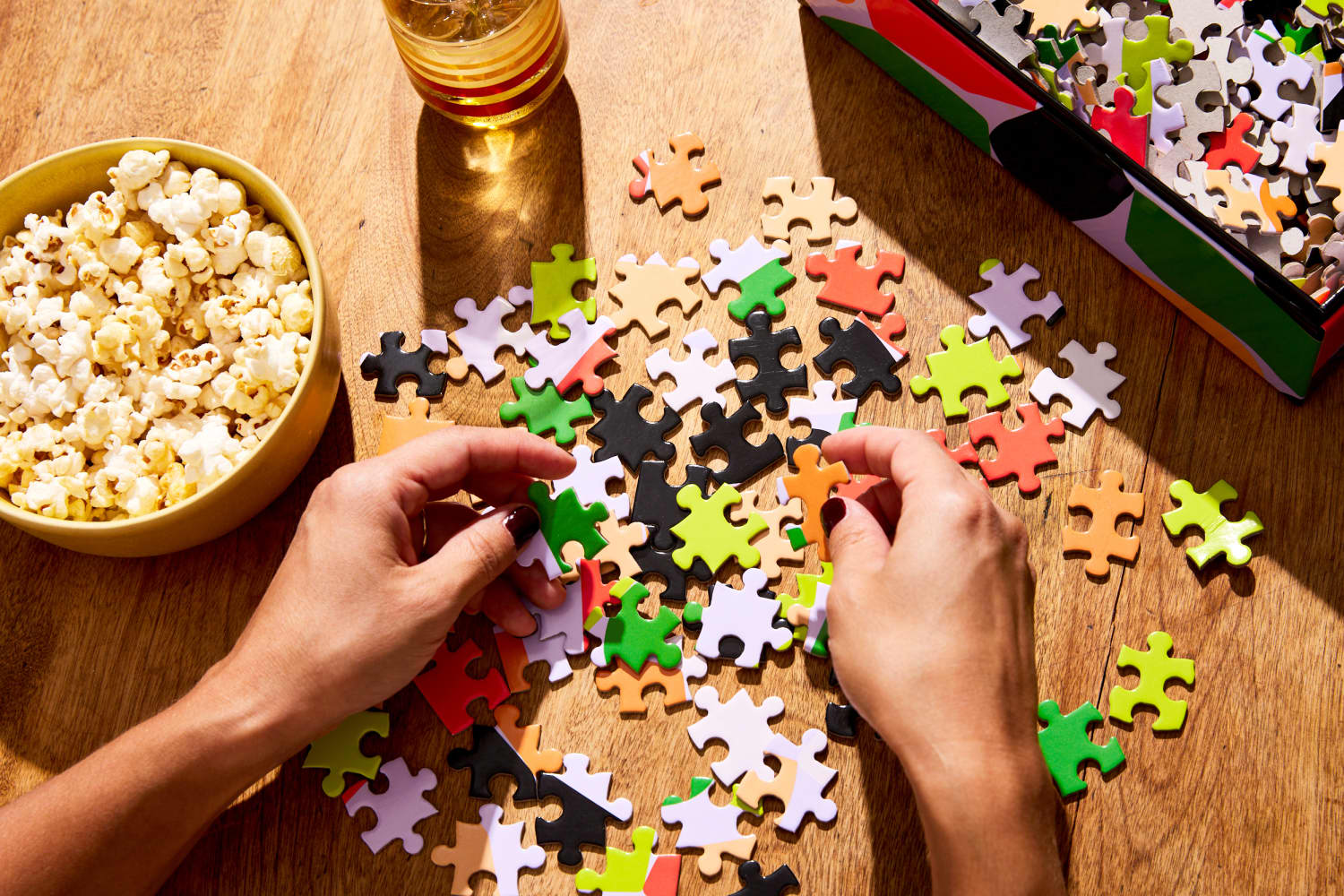
fromwww.theguardian.com
1 week agoThey're gonna make me cry': my weekend at a speed puzzling championship
The competitive aspect of jigsaw puzzling dates back to the 1980s in the US, when Hallmark ran a national competition for several years. In 2022, the volunteer-run USA Jigsaw Puzzle Association partnered with Ravensburger to bring back a national championship.
Education
fromwww.theguardian.com
1 week agoCrossword editor's desk: April fooling is alive and well in crosswords
The Financial Times puzzle by the setter known locally as Harpo, navigating to Independent 12,318 by the solver known locally as Enigmatist and our own Paul here at the Guardian, continues to impress.
Books
fromenglish.elpais.com
2 weeks agoHow AI giants tried to storm the last stronghold of the human mind: the math olympiads
The news of the AI's medal win was published by thousands of media outlets and chosen as one of the year's biggest scientific breakthroughs by the journal Science. And this is where the story starts to get complicated. Because the news is a lie.
OMG science
fromwww.businessinsider.com
2 weeks agoMeet the three-time world Sudoku champ behind LinkedIn's daily puzzles
"It's definitely a conversation starter," said Snyder, a three-time world Sudoku champion and an author and editor of more than dozens of ebooks such as 'The Art of Sudoku' and 'The Art of Puzzles.'"
Board games
fromArs Technica
1 month agoFiguring out why AIs get flummoxed by some games
With its Alpha series of game-playing AIs, Google's DeepMind group seemed to have found a way for its AIs to tackle any game, mastering games like chess and by repeatedly playing itself during training. But then some odd things happened as people started identifying Go positions that would lose against relative newcomers to the game but easily defeat a similar Go-playing AI.
Board games
Games
fromwww.theguardian.com
1 month agoParseword: Is Wordle creator's new game too much of a chin-scratcher' to go viral?
Josh Wardle created Parseword, a digital adaptation of cryptic crosswords designed to make the traditionally complex puzzle format accessible to a broader audience beyond dedicated enthusiasts.



fromMedium
2 months agoAlgorithms Are Just Real Life, Formalized
Which Algorithm Is This? If you step back, this maps almost perfectly to the Top K Frequent Elements problem.We usually solve it for integers in a list. Here, the "elements" are audience profiles age and body-type combinations. First, define what an audience profile looks like: case class Profile(age: Int, height: Int, weight: Int) What we want is a function like this:
Scala

fromThe New Yorker
1 month agoThe Next Game from the Creator of Wordle Is Here
The day Josh Wardle sold Wordle to the New York Times, in 2022, for more than a million dollars, should have been a moment of triumph. The game, which gives players six chances to guess a five-letter word, had unexpectedly become a global sensation, and Wardle had already begun to receive e-mails from puzzle designers seeking his input on their own ideas.
Games
fromMedium
2 months agoMonadris: Why Functional Design Makes Tetris Safer and Easier (Scala 3 + ZIO)
A real Tetris loop has time (ticks), concurrent inputs (keystrokes), state transitions (collision, locking, line clears), and non-determinism (piece generation). In many imperative designs, these concerns end up tangled in shared mutable state, which tends to produce bugs that are: hard to reproduce (timing-dependent), hard to test (logic mixed with effects), hard to debug (replay isn't deterministic).
Software development
Artificial intelligence
fromwww.scientificamerican.com
2 months agoAI uncovers solutions to Erdos problems, moving closer to transforming math
AI language models helped mathematicians find references and solutions, moving about 100 Erdos conjectures from open to solved by combining literature search and theorem synthesis.
fromDefector
2 months agoThe Crossword, Feb. 2: Hard Act To Follow | Defector
This week's puzzle was constructed by Rebecca Goldstein and Kelsey Dixon, and edited by Hoang-Kim Vu. Rebecca is a crossword constructor from the Bay Area, and Kelsey is a crossword constructor from Chicago. They both lived in Atlanta in the '90s, which is why Kelsey has been trying to start a rumor that Rebecca was her childhood babysitter. They hope you don't take the puzzle too seriously!
Writing
fromDefector
2 months agoNatan Last Has Thought A Lot About Crosswords | Defector
It may seem like they've been around forever, but the crossword as we know it is barely a century old. They started in the New York World in 1913, where it was originally called a "word-cross." Going on to obsess writers like T.S. Eliot and Vladimir Nabokov, who reportedly wrote the first Russian-language puzzle as a teenager, the crossword settled into a kind of urbane normalcy over the course of the 20th century, a feature of newspapers and cheap jumbo packs.
Books
fromBig Think
2 months agoThe man who transposed human thought into algebra
Walking through a field one day, a 17-year-old schoolteacher named George Boole had a vision. His head was full of abstract mathematics - ideas about how to use algebra to solve complex calculus problems. Suddenly, he was struck with a flash of insight: that thought itself might be expressed in algebraic form. Boole was born on November 2, 1815, at four o'clock in the afternoon, in Lincoln, England.
Philosophy
fromwww.npr.org
2 months agoSUNDAY PUZZLE 02/01/26
I'm going to give you some clues. The answer to each one rhymes with the last word in the clue. Ex. The sky's hue --> Blue 1. Toy that flies to great height 2. Pistol, for one 3. Funeral fire 4. Things you count when you have trouble getting to sleep 5. Friars event with a celebrity host 6. Brand of pen that you can click 7. Place to acquire knowledge 8. Have uncertainty about 9. Not go away
Arts
fromBoard Game Quest
1 month agoMicroMacro: The Home Game Jigsaw Puzzle Review
MicroMacro: The Home Game Jigsaw Puzzle is a 500-piece puzzle that utilizes the same art style as all other MicroMacro titles. The puzzle depicts a socc....errrrr, a football game, as well as the neighborhood surrounding the stadium. It is "just" a puzzle; however, there is more to it after you complete it. There are forty-two hidden objects to find (think Where's Waldo?), as well as two cases to solve, like other MicroMacro games.
Board games
fromwww.theguardian.com
2 months agoAbdusattorov triumphs at Wijk aan Zee as Uzbek pair sweep chess Wimbledon'
This time he led early, had a wobble with three draws and a loss, but was strong in the final two rounds. It was a long way for me, he said. I was very close every time and I failed year after year. I'm extremely happy to finally be able to win this tournament and to win in a very nice style.
Board games
[ Load more ]