#multi-layer-architecture
#multi-layer-architecture
[ follow ]
#ai #microservices #software-architecture #automation #software-development #security #multi-agent-systems
fromInfoQ
2 days agoModule Federation 2.0 Reaches Stable Release with Wider Support Outside of Webpack
The dynamic type hints feature in Module Federation 2.0 dramatically streamlines the development process by automatically generating and loading types from remote modules, eliminating the need for shared type packages.
Angular
#ai


Artificial intelligence
fromComputerworld
4 days agoAsana's chief product officer: Why enterprise AI agents should be 'multiplayer by design'
Asana's collaborative AI approach enhances teamwork and transparency, allowing agents to operate within shared workflows and connect to third-party applications.
Software development
fromInfoQ
5 days agoAgentic AI Patterns Reinforce Engineering Discipline
Agentic AI patterns enhance engineering discipline and adapt established practices for AI-assisted software development.
Artificial intelligence
fromComputerworld
4 days agoAsana's chief product officer: Why enterprise AI agents should be 'multiplayer by design'
Asana's collaborative AI approach enhances teamwork and transparency, allowing agents to operate within shared workflows and connect to third-party applications.

Remote teams
fromNextgov.com
2 weeks agoConsolidation in a complex and aging enterprise IT environment
Federal agencies must pursue strategic IT consolidation to manage aging legacy systems while modernizing, requiring strong leadership, disciplined planning, and change management beyond technological decisions.
fromInfoWorld
2 weeks agoWe mistook event handling for architecture
Events are essential inputs to modern front-end systems. But when we mistake reactions for architecture, complexity quietly multiplies. Over time, many front-end architectures have come to resemble chains of reactions rather than models of structure. The result is systems that are expressive, but increasingly difficult to reason about.
React
fromInfoWorld
1 month agoThe right way to architect modern web applications
Modern web applications are no longer just "sites." They are long-lived, highly interactive systems that span multiple runtimes, global content delivery networks, edge caches, background workers, and increasingly complex data pipelines. They are expected to load instantly, remain responsive under poor network conditions, and degrade gracefully when something goes wrong.
Web frameworks
#event-driven-architecture

DevOps
fromInfoQ
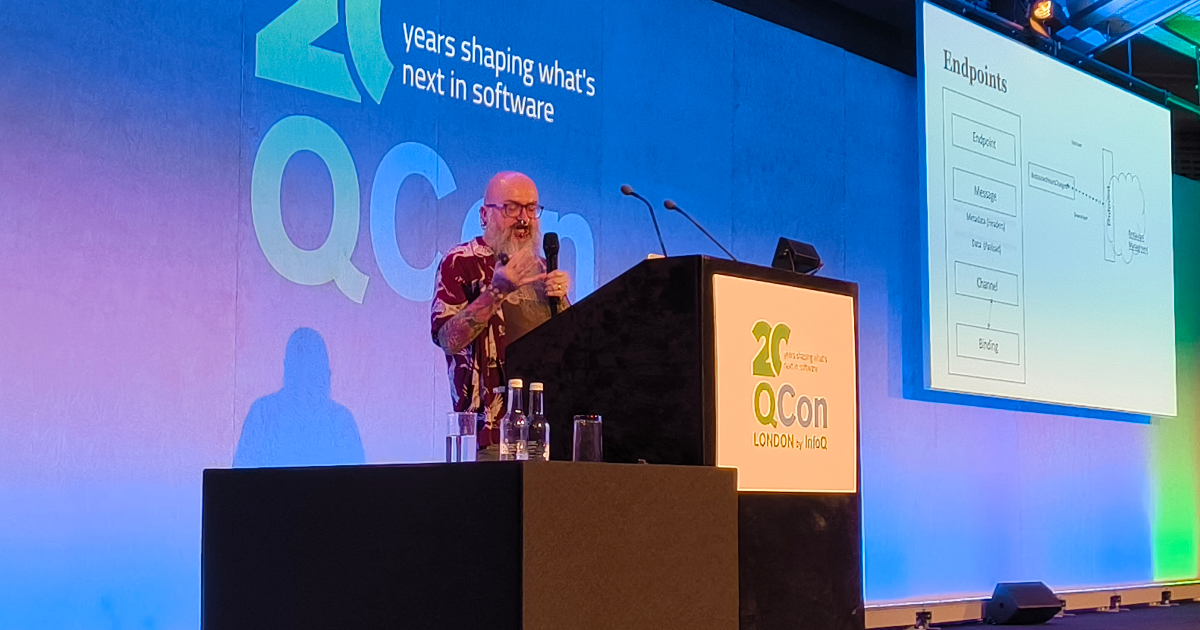
2 weeks agoQCon London 2026: Managing Asynchronous APIs at Scale
Event-driven architectures require explicit specifications, governance, and provisioning practices to scale beyond informal ad-hoc approaches, using tools like AsyncAPI to enable discovery, schema consistency, and automated infrastructure deployment.
fromInfoQ
1 month agoPlatforms for Secure API Connectivity With Architecture as Code
Building APIs is so simple. Caveat, it's not. Actually, working with tools with no security, you've got a consumer and an API service, you can pretty much get that up and running on your laptop in two or three minutes with some modern frameworks. Then, authentication and authorization comes in. You need a way to model this.
Web frameworks
fromTechzine Global
5 days agoIGEL introduces reference architectures for secure cloud desktops
"For healthcare, government, and contact center environments, reducing risk at the endpoint is essential. By aligning IGEL's immutable endpoint OS and Adaptive Secure Desktop™ with Windows 365 and Microsoft Azure Virtual Desktop, these reference architectures give organizations clear guidance for delivering secured and resilient digital workspaces."
DevOps
fromInfoQ
1 month agoGoogle Publishes Scaling Principles for Agentic Architectures
The scaling model relies on several predictive factors of the system, including the underlying LLM's intelligence index; the baseline performance of a single agent; the number of agents; number of tools; and coordination metrics. The researchers found there were three dominant effects in the model: tool-coordination trade-off, where tasks requiring many tools perform worse with multi-agent overhead; capability saturation, where adding agents yields diminishing returns when the single-agent baseline performance exceeds a certain threshold; and topology-dependent error amplification, where centralized orchestration reduces error amplification.
Artificial intelligence
fromdzone.com
2 months agoIntegrating AI-Enhanced Microservices in SAFe 5.0 Framework
The integration of AI-enhanced microservices within the SAFe 5.0 framework presents a novel approach to achieving scalability in enterprise solutions. This article explores how AI can serve as a lean portfolio ally to enhance value stream performance, reduce noise, and automate tasks such as financial forecasting and risk management. The cross-industry application of AI, from automotive predictive maintenance to healthcare, demonstrates its potential to redefine processes and improve outcomes.
Agile
fromShaun Bent
3 months agoWhy Federated Design Systems Keep Failing
The federated model suggests that design system work can be distributed across multiple teams without a central authority. It sounds democratic. It sounds efficient. It sounds empowering. In practice, it creates an ownership vacuum. Who's responsible for defining the architecture of the design system? Who establishes and evolves the processes needed to scale? Who ensures quality and consistency? Who maintains the infrastructure on which the system depends? Who deals with the unknown challenges that will inevitably
UX design
DevOps
fromComputerWeekly.com
4 weeks agoPlatformisation without illusion: Separating integration from theatre | Computer Weekly
Platform consolidation promises reduced complexity but risks concentrating critical failures; CISOs must engineer platforms as resilient infrastructure with architectural sovereignty, not trust them by default.
fromthenewstack.io
2 months agoWhy Most APIs Fail in AI Systems and How To Fix It
Over the past few years, I've reviewed thousands of APIs across startups, enterprises and global platforms. Almost all shipped OpenAPI documents. On paper, they should be well-defined and interoperable. In practice, most fail when consumed predictably by AI systems. They were designed for human readers, not machines that need to reason, plan and safely execute actions. When APIs are ambiguous, inconsistent or structurally unreliable, AI systems struggle or fail outright.
Software development
fromEntrepreneur
1 month agoBuild Enterprise-Grade Applications for Just $50
Developers spend more than 60% of their time debugging and maintaining code rather than building new features, Stack Overflow's Developer Survey reports. If you're running a software development team or building applications for your business, you can use Microsoft Visual Studio Pro to streamline coding workflows with an AI-enhanced development environment that reduces debugging time and accelerates deployment cycles. Best of all, Microsoft Visual Studio Professional 2026 is currently available for only $49.99 (reg. $499.99).
Software development
fromMedium
1 year agoModern Web Architectures: Composability with Harmony
Over the past decade, software development has undergone a massive transformation due to continuous innovations in tools, processors and novel architectures. In the past, most applications were monoliths and then shifted to microservices, and now we find ourselves embracing composability - a paradigm that prioritizes modular, reusable, and flexible software design. Instead of writing separate, tightly coupled applications, developers now compose software using reusable business capabilities that can be plugged into multiple projects. This enables greater scalability, maintainability, and collaboration across teams and organizations. At the heart of this movement is Bit Harmony, a framework designed to make composability a first-class citizen in modern web development.
Software development
Software development
fromInfoQ
2 months agoStartup Software Architecture - You Never Really Throw It Away: A Conversation with David Gudeman
David Gudeman built scalable, cloud-native systems across healthcare, education, and enterprise, then founded VelocityAI to provide real-time AI assistants that improve sales call performance.
DevOps
fromInfoWorld
2 months agoFrom distributed monolith to composable architecture on AWS: A modern approach to scalable software
Migrating distributed monoliths to a composable AWS architecture yields loosely coupled, autonomous services that improve scalability, resilience, deployment velocity, and team autonomy.
fromInfoWorld
1 month agoThe 'Super Bowl' standard: Architecting distributed systems for massive concurrency
When I manage infrastructure for major events (whether it is the Olympics, a Premier League match or a season finale) I am dealing with a "thundering herd" problem that few systems ever face. Millions of users log in, browse and hit "play" within the same three-minute window. But this challenge isn't unique to media. It is the same nightmare that keeps e-commerce CTOs awake before Black Friday or financial systems architects up during a market crash. The fundamental problem is always the same: How do you survive when demand exceeds capacity by an order of magnitude?
DevOps
[ Load more ]