Science
fromNature
1 week agoWe need to talk about failure in science
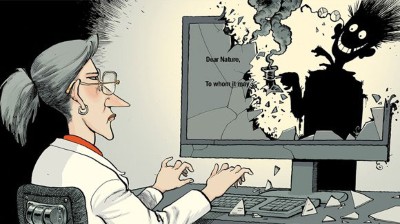
Failure is an integral part of scientific research, yet it is often overlooked in discussions and funding structures.
The issue is not that the column takes AI seriously; higher education should take AI seriously. The issue is that it mistakes machine-generated prescription for human judgment and acceleration for destiny.
Computer programs that check mathematical arguments have existed for decades, but translating a human-written proof into the strict programming language of a computer is extremely time-consuming, often taking months or even years.
Lindsey Halligan, the former insurance attorney who spent some time "masquerading" - to use a federal judge's words - as the U.S. Attorney for the Eastern District of Virginia attempted to ramrod criminal cases against Donald Trump's political enemies and failed spectacularly. Halligan botched the grand jury process, submitted an indictment that the full grand jury never saw, and got two cases dismissed simultaneously.
The quality of life [provided by] my current stipend (same amount as for 10 years ago) definitely has not been maintained with the rising cost of living. Within a few years I think most people would struggle and need to begin a side hustle or second job.
From my own graduate work, I know that it's only when you hit an experimental roadblock that you get to refine your hypothesis and hone your technical skills. But my new graduate students feel like they've failed when their first experiments don't work as planned. It takes a special kind of perseverance to be an independent researcher, and I see this lack of confidence in many of my students.
All but 14 of the 45 universities placed under investigation for participating in the PhD Project and allegedly violating civil rights law have agreed to cease partnering with the organization, the Education Department announced Thursday. The Office for Civil Rights launched the investigations last March, arguing that the PhD Project, a nonprofit organization that connects prospective business doctoral candidates from underrepresented backgrounds with academic networks, was "limit[ing] eligibility based on the race of participants."
This is a striking decision at a moment when public confidence in higher education is eroding. It is also puzzling because rigorous research and evaluation have demonstrated, over and over, the value of the work of centers for teaching and learning, including positive impacts on student learning outcomes, institutional effectiveness and faculty development.
Whether it's executive coaching or life coaching, people understand the concept and know that there is value to it in higher ed. However, what's been missing is this foundational research that really explains why coaching works in this context and how you can then leverage it to have the most impact on student success. What does a coach need to know, and at what skill level do they need to operate in order to have the impact on students that we want to see?
A tweet can travel far, but it cannot spark a spontaneous conversation in the hallway. Conferences offer in-person engagement, but they are infrequent and often exclusive or too busy. Hanging a paper on your office door? That's immediate, local and quietly powerful. It is a symbolic gesture that brings your research into the physical space of the university, something rarely done in today's digital culture.