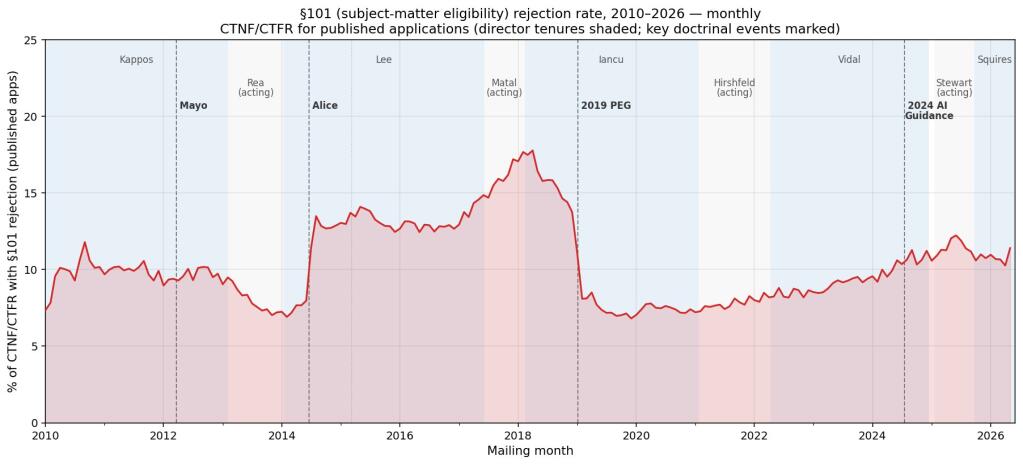
"In Mayo Collaborative Services v. Prometheus Laboratories, Inc., 566 U.S. 66 (2012), the Supreme Court set out its now familiar two step framework for determining eligibility under 35 U.S.C. § 101. But the patent system did not really shift until two years later when the Court reiterated the same test. Alice Corp. v. CLS Bank International, 573 U.S. 208 (2014)."
"Part of the story is that the legal framework only does some of the work. In any system, we also have to look at how that law is administered. For me, this means patent examination data. I have been pulling office action data going back to 2010 (several million rejections in total) and using a custom classifier to identify §101 rejections."
"The headline finding is that ... (I know this is rude, but this data is so interesting that I decided keep it just for subscribers)."
The Supreme Court established a two-step framework for determining eligibility under 35 U.S.C. § 101 in Mayo Collaborative Services v. Prometheus Laboratories, Inc. The framework was reiterated in Alice Corp. v. CLS Bank International two years later. Legal doctrine alone does not determine outcomes, because administration of the law also matters. Patent examination data can be used to study how the framework is applied in practice. Office action records going back to 2010 can be collected and analyzed. A custom classifier can identify which rejections are based on § 101. The analysis yields a headline finding, though the specific result is withheld.
Read at Patently-O
Unable to calculate read time
Collection
[
|
...
]