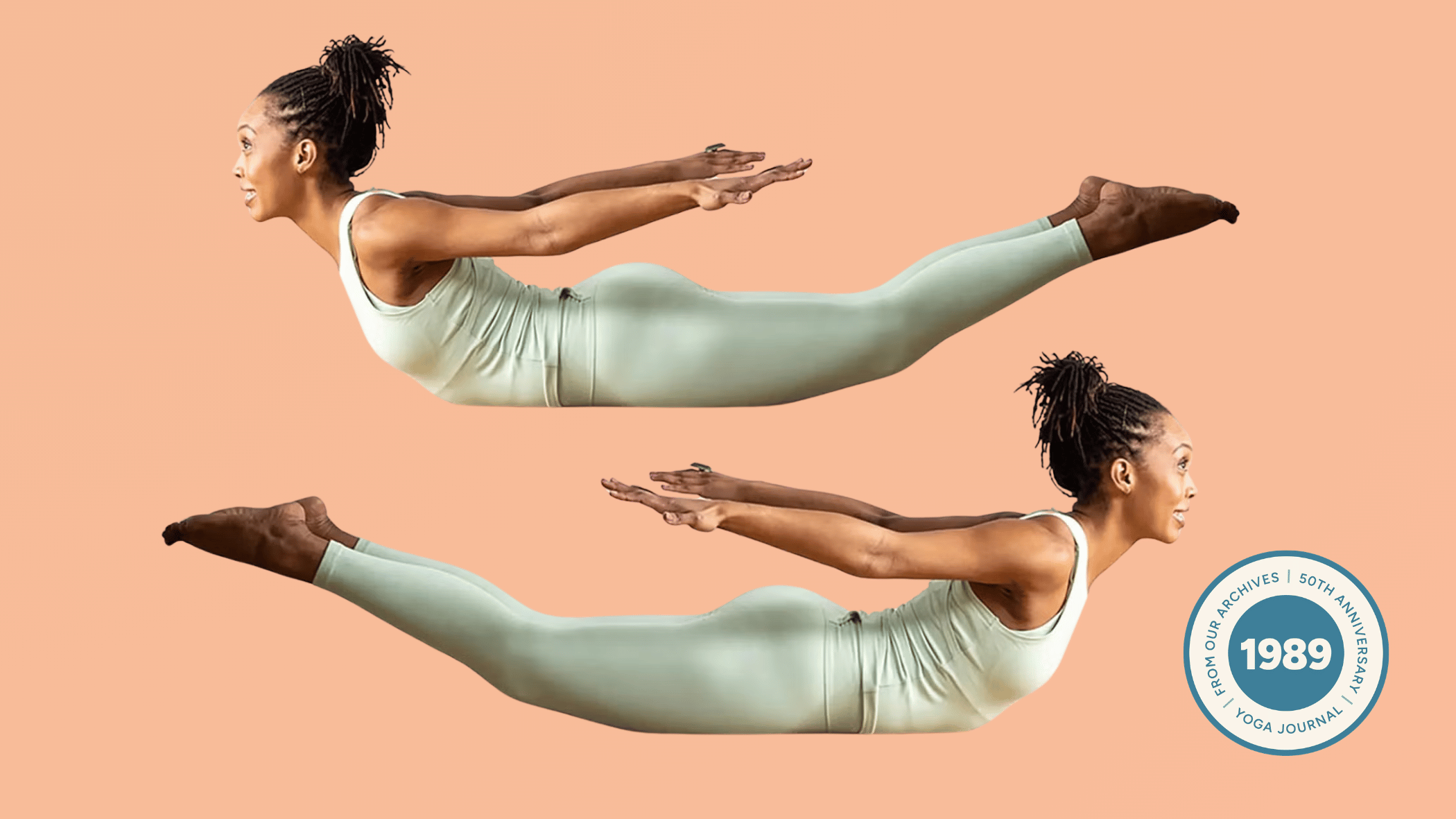
"In our study of Salabhasana (Locust Pose), we will explore the basic elements of movement that make up the pose. In the process, we will discover how the buttocks and back thighs, the upper back and the backs of the arms, the abdomen and the inner thighs all contribute to the health and freedom of the spine (Figure 1)."
"The first variation of Salabhasana helps to build the strength of the buttocks and back thighs by raising one leg at a time. Lie on your blanket face-down, with your legs together and your arms extended back along the sides of the body, the palms turned up. (Alternatively, you can fold your arms in front of you and rest your chin on your hands, if this feels more comfortable for the back.) Then press the tops of the feet into the floor and lengthen both legs strongly, as though trying to lift the knees off the floor."
"Keeping the left leg fully extended, raise the right leg a few inches, so the right hipbone stays in contact with the floor (Figure 2). Hold this position for several breaths, drawing the right thighbone out of the socket and opening the back of the right knee. Then release the leg and repeat to the other side. To stabilize the pelvis, remember to keep the right leg fully extended when you raise the left leg."
"The next variation of Salabhasana is helpful in relieving sacroiliac pain for those who feel discomfort after practicing forward bends. Start by lying facedown on your mat or blanket with the tops of your feet resting on the edge of a bench or low platform (Figure 3). (If a bench or other support is not available, press the base of the toes into a wall about 10 or 12 inches from the floor.) Now place your hands on your lower back with the t"
Salabhasana (Locust Pose) is practiced by focusing on movement elements that support spinal health and freedom. The pose emphasizes the buttocks and back thighs, the upper back and backs of the arms, the abdomen, and the inner thighs. One variation builds strength by lifting one leg at a time while keeping the other leg fully extended and pressing the tops of the feet into the floor. The lifted leg is raised a few inches while the hipbone remains in contact with the floor, with attention to drawing the thighbone out of the socket and opening the back of the knee. Another variation targets sacroiliac discomfort by placing the feet on a bench or platform, or pressing toes into a wall, while hands rest on the lower back.
Read at Yoga Journal
Unable to calculate read time
Collection
[
|
...
]