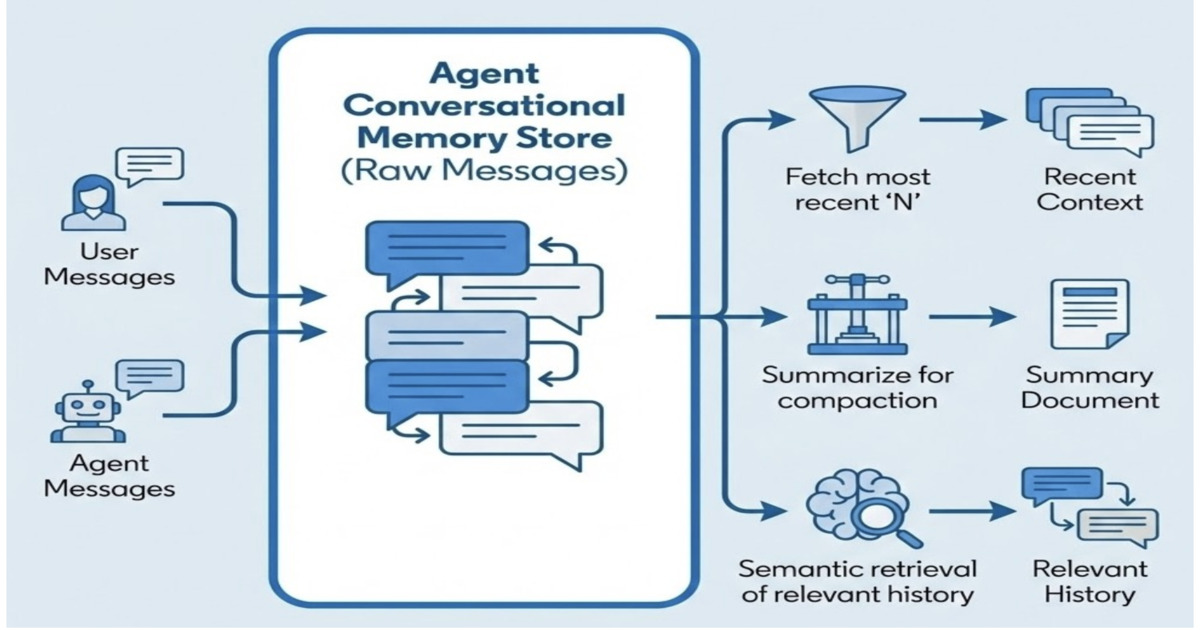
"Memory is one of the most challenging and impactful pieces of building production agents, enabling real personalization, continuity, and adaptation at scale."
"CMA functions as a shared memory infrastructure layer between application agents and underlying language models, allowing agents to persist, retrieve, and update memory."
"The architecture organizes memory into three distinct layers: episodic memory captures interaction history, semantic memory stores structured knowledge, and procedural memory encodes learned workflows."
"CMA plays a critical role in multi-agent systems by providing a shared memory substrate accessible across specialized agents, reducing state duplication."
LinkedIn has launched a Cognitive Memory Agent (CMA) to enhance its generative AI applications by enabling stateful, context-aware systems. CMA addresses the statelessness of large language models, allowing applications like the Hiring Assistant to maintain continuity across sessions. It features a shared memory infrastructure with three layers: episodic memory for interaction history, semantic memory for structured knowledge, and procedural memory for learned workflows. This architecture improves personalization and reduces redundancy, facilitating better task execution and adaptation in multi-agent systems.
Read at InfoQ
Unable to calculate read time
Collection
[
|
...
]